 Image: Jan van Eyck, public domain
The Lamb in the Ghent Altarpiece looks back
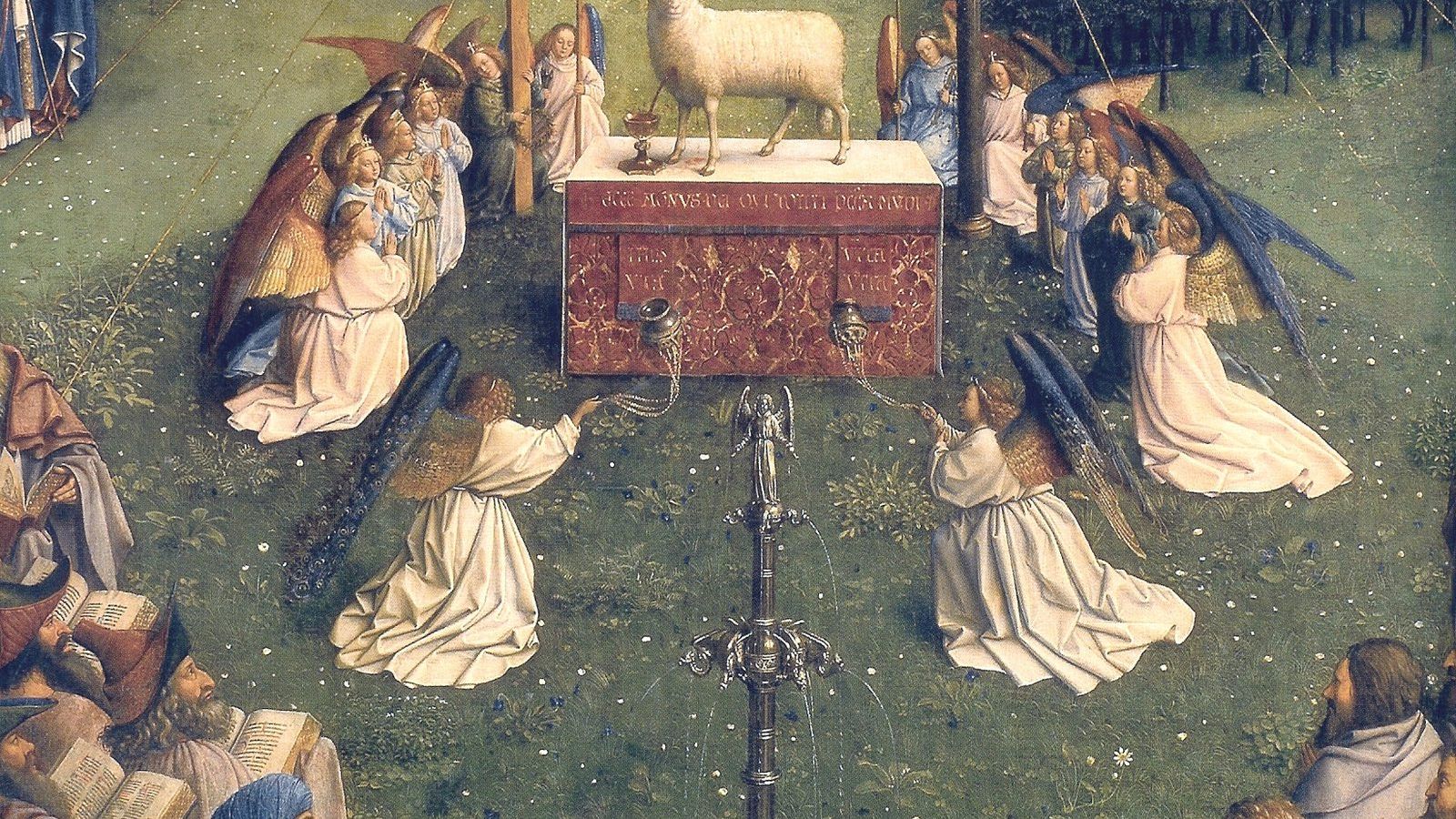
At the centre of the lower register of the Ghent Altarpiece, in Saint Bavo's Cathedral in Ghent, a lamb stands on an altar in a meadow and bleeds into a chalice while angels, prophets, apostles, martyrs, and pilgrims gather from the four corners of the panel. The quatrain painted on the frame says that Hubert van Eyck began the work and Jan, his brother, completed it, and gives the date of 6 May 1432. For as long as anyone had photographed the altarpiece, the Lamb had a sheep's face: a long muzzle, eyes at the sides of the head, a placid animal. In December 2019 the conservators of the Royal Institute for Cultural Heritage in Brussels announced that the face was not the Van Eycks' at all.
What the conservators found
The restoration began in October 2012 and was done in three phases in a glass-walled studio inside the Museum of Fine Arts in Ghent, where the public could watch. The first phase, from 2012 to 2016, treated the exterior panels, the ones seen when the altarpiece is closed. The second, from 2016 to 2019, treated the lower register of the interior, including the Adoration of the Lamb. The upper register is the third phase.
The findings were presented on 17 December 2019 and are documented on the institute's website Closer to Van Eyck, where every panel can be examined in macrophotography, infrared reflectography, and X-radiography. The central panel had been overpainted far more than anyone suspected: about 45 per cent of its surface carried paint from the sixteenth century, laid over the original in a campaign of restoration that the documents place around 1550. The overpainters had followed the Van Eycks closely in most places, which is why nobody noticed, and then departed from them in a few. The sky had been covered. The buildings on the horizon had been repainted. And the Lamb had been given a new face.
Under the overpaint the original Lamb has a shorter muzzle, a smaller head, and two eyes set towards the front of the face, looking out of the picture at the viewer. Its ears sit differently, which is why, for a few weeks in 2019 while the work was in progress, photographs showed a Lamb with four ears, two of the original and two of the sixteenth century. The conservators found that only about 3 per cent of the Van Eycks' paint had been lost over the centuries. What had changed the picture was addition, not loss.
Why the face matters
The Lamb is Christ. The inscription on the altar names it as the Lamb of God who takes away the sins of the world, and the blood that runs into the chalice is the Eucharist. A lamb that looks out of the picture at the congregation is a theological statement: it addresses the person in front of the altar, as the icons of Unit 3 of the masterclass address their viewers. The sixteenth-century restorer, working in a time when a human-eyed animal may have seemed strange or improper, gave it the eyes of a sheep and turned a presence into an animal. The Van Eycks' Lamb, with its direct gaze, is closer in spirit to the Christ of the upper register than the overpainted one ever was.
The reaction in December 2019 was loud, and much of it was mockery of the face as unsettling. Unit 5 of the masterclass treats the reaction as evidence. The face was always there; what the public found strange was the fifteenth century seen without the sixteenth century's correction.
How the layers were read
The decision to remove overpaint is never taken on the evidence of the eye. The conservators examined cross-sections of the paint under the microscope, where the Van Eycks' layers and the later ones lie one on top of the other and can be told apart by their pigments and their binding medium. Infrared reflectography showed the original underdrawing beneath both. X-radiography showed the lead white of the original highlights through the overpaint. Where the original paint beneath was intact, the overpaint was removed with solvents and scalpels under magnification, millimetre by millimetre. Where it was not, the overpaint stayed. The whole process is documented on the institute's site at a resolution that lets you follow it, and Unit 5 asks you to open a cross-section and read it layer by layer.
The altarpiece's other adventures
The Ghent Altarpiece has been the most stolen work of art in history, and Unit 11 of the masterclass uses it as a case in the museum's and the state's claims on art. In 1794 French revolutionary troops took the central panels to Paris, where they hung in the Louvre until Napoleon's defeat returned them in 1815. The following year the cathedral sold the wings, which passed to the King of Prussia and were sawn apart so that both sides could be shown at once in Berlin. The Treaty of Versailles in 1919 returned them to Ghent. In 1934 the panel of the Just Judges was stolen from the cathedral, a ransom demanded, and the panel never recovered; the copy that hangs in its place was painted by Jef Van der Veken in the 1940s. In 1940 the altarpiece was sent to Pau in southern France for safety, seized from there by German order in 1942, stored at Neuschwanstein and then in the salt mine at Altaussee, and brought back to Belgium in 1945 by the Allied officers whom the film industry later called the Monuments Men.
Every one of these journeys left marks. Panels were sawn, frames lost, surfaces abraded. The restoration of 2012 to 2019 was the first time the whole object had been examined with the methods of modern conservation, and the first time the public could see what the Van Eycks painted rather than what the sixteenth century thought they should have painted.
Seeing it now
The altarpiece is shown in the cathedral in a glass case in the Sacrament Chapel, with the panels of the second phase restored and the upper register in its earlier state until the third phase is complete. The website is in some ways the better place to see it, because no visitor can get within a few centimetres of the surface and the macrophotographs put you there. Open the Lamb, switch between before and after treatment, and look at the eyes.
Unit 5 of the Art History Masterclass reads the Ghent Altarpiece in its open and closed states and explains the oil glaze technique that keeps it glowing; Unit 11 follows its thefts and returns. The curriculum describes both, and a companion article reads the mirror in Van Eyck's Arnolfini Portrait.