 Image: Han van Meegeren, public domain
How Han van Meegeren fooled the experts
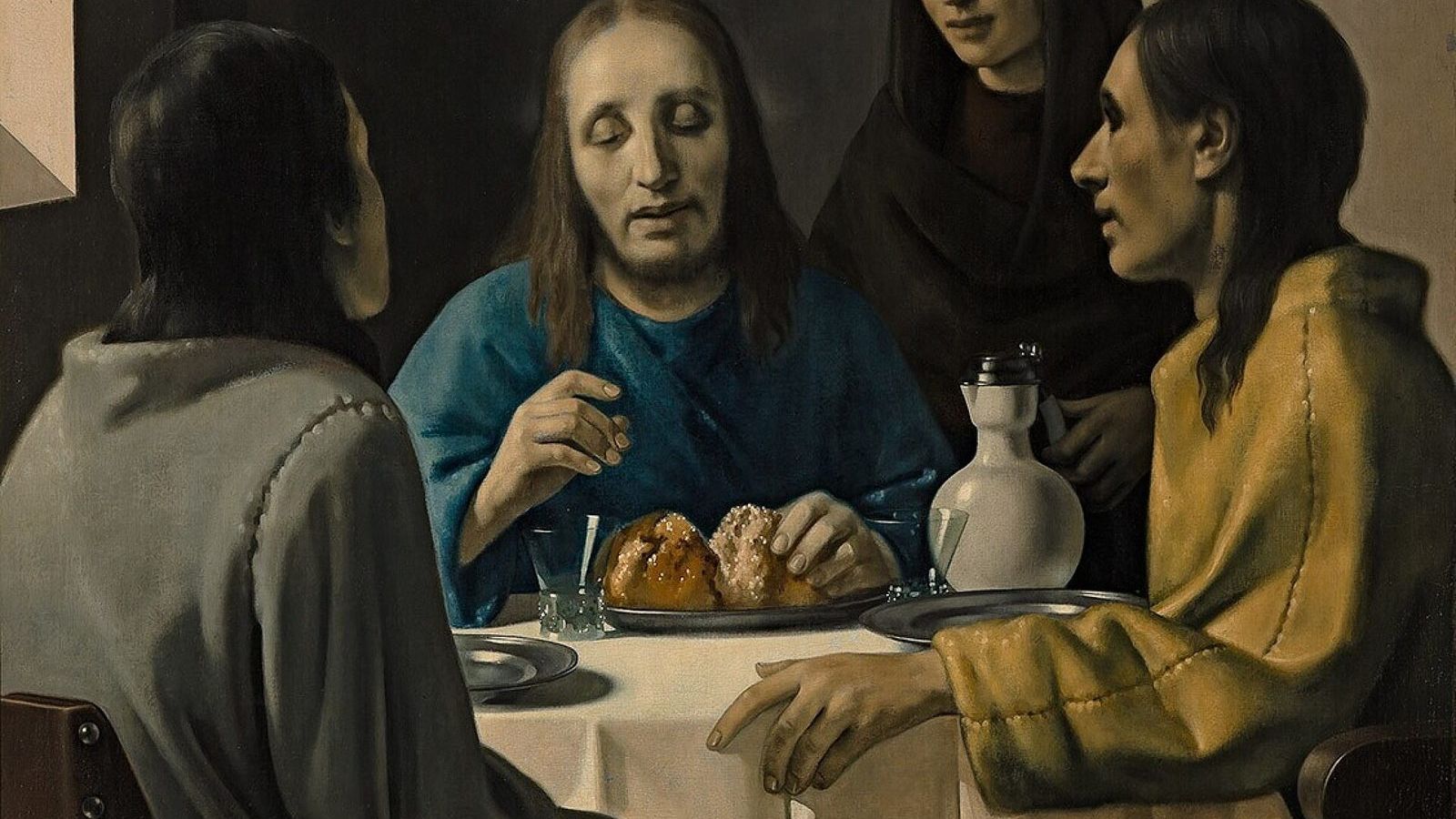
In November 1937 Abraham Bredius, eighty-two years old and the most respected authority on Dutch painting alive, published a short article in The Burlington Magazine under the title A New Vermeer. He had been shown a large canvas of Christ at the table at Emmaus, breaking bread with two disciples while a servant looks on, and he wrote that it was the masterpiece of Johannes Vermeer of Delft, untouched, on the original canvas, and quite different from his other paintings. The Museum Boijmans in Rotterdam bought it the following year for 520,000 guilders, raised by subscription, and hung it as the centrepiece of an exhibition of Dutch masterpieces. It is still in the museum, catalogued under the name of the man who painted it in 1936 and 1937: Han van Meegeren.
Why the experts were ready
A forger does not fool experts by imitating what they know. He paints what they expect to find. Vermeer's early paintings, before the quiet interiors, include large religious scenes in the Italian manner, and art historians in the 1930s suspected that he had spent a period under the influence of Caravaggio and that paintings from that period were missing. Bredius himself had argued it. Van Meegeren, a Dutch painter whose own work had been dismissed by the critics he hated, gave them the missing period. The Emmaus is a Caravaggesque composition, with a strong light from the left, a plain table, and the dignified faces that the scholars of the 1930s associated with Vermeer. It confirmed a theory. That is a harder thing to doubt than a picture.
How it was made
The craft was patient. Van Meegeren bought a genuine seventeenth-century painting of no value and scraped most of it off, keeping the old canvas, the old stretcher, and the ground, so that the back of the picture and the edges would pass inspection. He ground his own pigments from the materials of the period, including natural ultramarine from lapis lazuli, which no forger using modern paint would have paid for. The problem was the medium. Oil paint takes decades to harden fully, and an expert's first test is to touch a cotton swab with alcohol to the surface: fresh oil softens, old oil does not. Van Meegeren solved it with Bakelite. He mixed his pigments with phenol formaldehyde resin, the material of early plastics, painted the picture, and baked the canvas in an oven at over a hundred degrees for hours. The resin set hard. He then rolled the canvas over a cylinder to crack the surface, rubbed black ink into the cracks to simulate the dirt of centuries, and varnished it. The swab came away clean.
The business
Between 1937 and 1945 Van Meegeren sold six Vermeers and two paintings attributed to Pieter de Hooch, through intermediaries, to museums and collectors in the Netherlands, for a total of about seven million guilders. None was as good as the first. The later ones are stiff and coarse, and the faces repeat, but by then the Emmaus had made the type, and each new picture was compared with it rather than with Vermeer. One of them, Christ with the Adulteress, was sold in 1943 for 1.65 million guilders to Hermann Göring, who exchanged for it a large number of Dutch paintings he had acquired during the occupation.
The arrest
When the war ended, Allied investigators found the painting in Göring's collection and traced the sale. On 29 May 1945 Van Meegeren was arrested in Amsterdam on a charge of collaboration, for having sold a national treasure to the enemy, which carried a possible death sentence. After some weeks in custody he announced that the Vermeer was his own work, and so were the others. The police did not believe him. To prove it, between July and December 1945, in a studio under guard, he painted a new picture in the same manner, The Young Christ Teaching in the Temple, using the same materials and the same oven. It was enough to change the charge.
The proof
The scientific case was made by a commission under Paul Coremans, a Belgian chemist who later founded the institute in Brussels that restored the Ghent Altarpiece. His team took samples from the paintings and found phenol formaldehyde resin in the paint, a substance that did not exist before the twentieth century. X-radiographs showed the ghosts of the scraped seventeenth-century compositions underneath. In one picture they found cobalt blue, a pigment first made in 1802, mixed into what was supposed to be ultramarine. The cracks, under the microscope, did not go through the paint as age cracks do but were pressed into it from outside. Each test alone could be argued with. Together they were conclusive, and Unit 11 of the masterclass reads them as a case in how a laboratory settles an attribution that the eye could not.
The trial and after
Van Meegeren was tried in Amsterdam on 29 October 1947, on charges of fraud and forgery rather than collaboration, and sentenced on 12 November to one year in prison, the minimum. He had become a popular figure, the man who had cheated Göring. He died of a heart attack on 30 December 1947, before serving the sentence. Bredius had died in 1946. The Emmaus stayed in Rotterdam, where visitors still ask to see it, and where the museum shows it as what it is.
What the case teaches
Attribution is an argument from three kinds of evidence: the style, the documents, and the materials. The Emmaus had no documents, which should have been a warning, and its style matched a theory rather than a body of work. Only the materials could not be argued with, and only once somebody asked. The habit the case teaches is the fourth of the masterclass's four questions, how do we know, and the lesson that a convincing story about a picture is the thing to be most careful of. The same lesson applies to the symbolism of the Arnolfini Portrait and to every attribution in the sale rooms, where the name on the label can be worth a thousand times the picture.
Unit 11 of the Art History Masterclass, Patrons, Collectors, and Museums, reads the Van Meegeren case alongside the Rembrandt Research Project's committee attributions and the sale of the Salvator Mundi for USD 450.3 million in 2017. The curriculum describes it.