 Image: Jan van Eyck, public domain
What the mirror in the Arnolfini Portrait shows
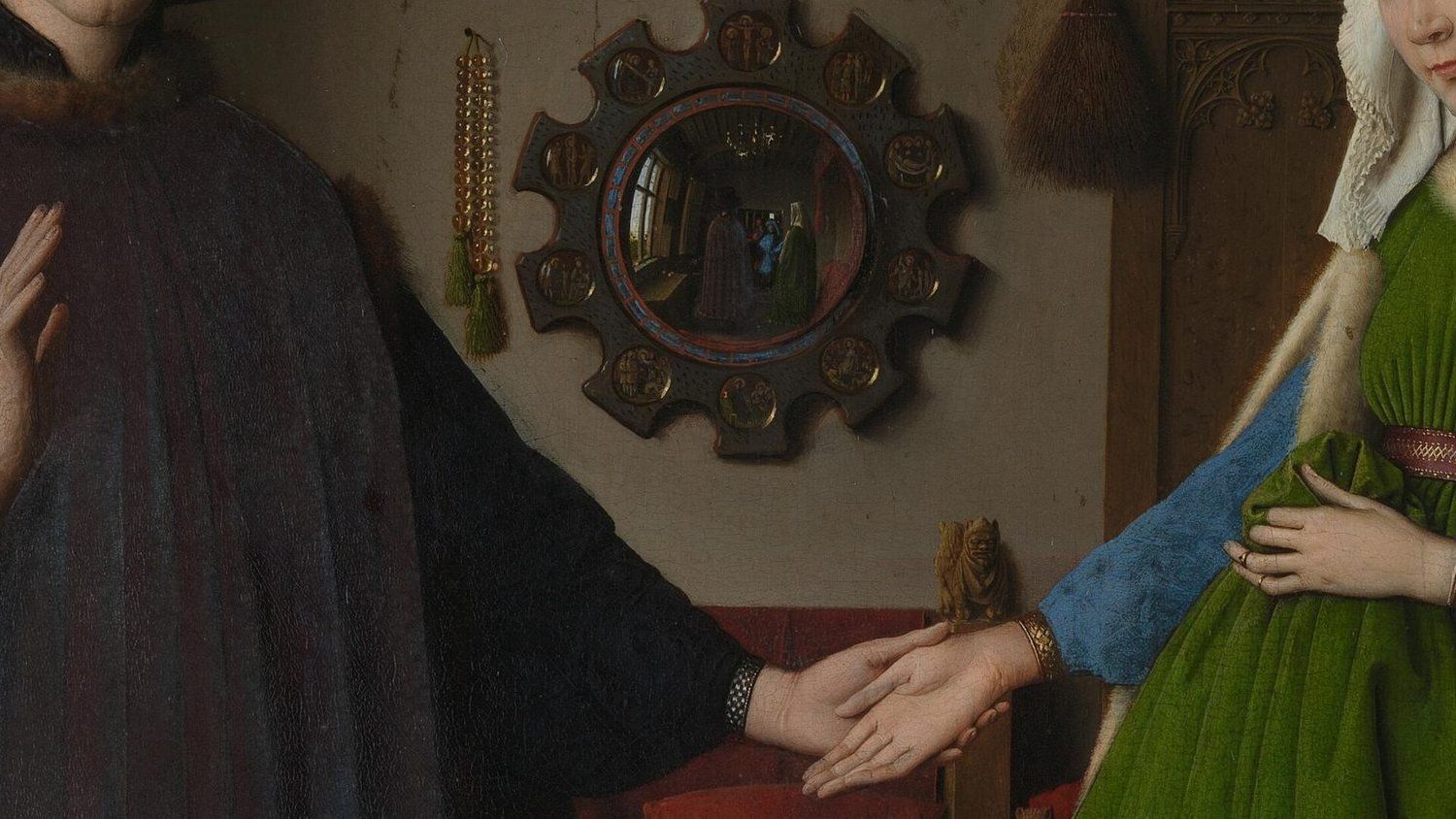
The Arnolfini Portrait in the National Gallery, London, is 82.2 cm high and 60 cm wide, painted in oil on three oak boards, and dated 1434. A man in a fur-lined tabard and a woman in a green gown stand in a bedroom. Behind them, on the back wall between the window and the bed, hangs a round convex mirror about ten centimetres across in a wooden frame. Most visitors see it, note that it is clever, and move on within the half minute that museum studies give to any picture. It rewards more than that, and it is the best place in the whole painting to practise the habit that an art historian has to learn: say what is there before you say what it means.
What is there
The mirror is convex, so it takes in more of the room than a flat glass would. In it you see the backs of the two figures, foreshortened and reduced, the window on the left, the bed on the right, and the ceiling beams running away to the far wall, which in the mirror is the wall the viewer stands against. In the doorway of that wall stand two small figures who are not in the main picture at all. One wears blue, the other red. They are entering the room, and they are where you are.
Around the glass the frame carries ten small roundels, each a scene from the Passion of Christ, painted at a scale where a head is the size of a pinhead. Read clockwise from the bottom, the scenes on the man's side show Christ alive, from the Agony in the Garden to the Crucifixion, and the scenes on the woman's side show him dead and risen, from the Deposition to the Resurrection. Between the roundels the frame shows glass or enamel studs. On the wall above the mirror, in a careful script that a notary might have used, Van Eyck wrote Johannes de eyck fuit hic 1434: Jan van Eyck was here, 1434.
That is the description. Nothing in it needs a theory. The next step, what it shows, is where the arguments begin, and it helps to know that the arguments have been running for ninety years.
The reading of 1934
In March 1934 Erwin Panofsky published an article in The Burlington Magazine that made this painting famous as a puzzle. He identified the couple as Giovanni Arnolfini, a merchant from Lucca living in Bruges, and his wife Giovanna Cenami, and he proposed that the picture records their marriage. The two figures in the mirror were the witnesses. The signature on the wall, in the formula of a legal document, was Van Eyck signing as one of them. Everything else in the room then fell into place as what Panofsky called disguised symbolism: the single lit candle in the chandelier on a bright day stood for the presence of God, the dog for fidelity, the oranges on the chest and the windowsill for the innocence before the Fall or simply for wealth, the discarded pattens for holy ground, the carved figure on the bedpost for Saint Margaret, patron of childbirth. Nothing in the picture was only itself.
The reading was elegant, and for fifty years it was taught as fact. It also became the model of a method. Panofsky's three levels, which he set out in 1939, moved from pre-iconographic description (a dog, a candle) to iconographic analysis (what a dog meant in 1434) to iconological interpretation (what the painting as a whole says about its time). Unit 1 of the masterclass teaches this sequence because it is useful. The Arnolfini Portrait is also the painting that shows where it can go wrong.
What the documents allow
Lorne Campbell, who catalogued the National Gallery's fifteenth-century Netherlandish paintings in 1998, went back to the archives in Lucca and Bruges. The marriage of Giovanni di Arrigo Arnolfini and Giovanna Cenami, he found, took place in 1447, thirteen years after the date on the wall and six years after Van Eyck's death. The picture could not record it. Campbell proposed a different Arnolfini, Giovanni di Nicolao, a cousin, who was in Bruges in the 1430s and whose first wife, Costanza Trenta, had died by 1433. Margaret Koster argued in 2003 that the painting might then be a memorial, with the woman's side of the mirror frame showing Christ dead and the candle on her side burnt out. The National Gallery's own text now says that the identity of the woman is unknown and that the picture may or may not show a marriage.
The symbols did not survive the examination either. Dogs appear in portraits of the period as pets. Oranges were expensive and a merchant from Lucca could afford them. The woman is not pregnant; she holds up the front of a full gown in the fashion of the 1430s, as women do in other paintings and in manuscript illuminations of the time where no pregnancy is intended. A single candle in a chandelier need not be a sacrament. None of this makes Panofsky foolish. It shows that a reading which explains everything should make a historian nervous, because a painting that explains everything was made by a theorist and not by a painter working for a client.
What the mirror does
Set the symbolism aside and the mirror still does three things that no painting before it had done. It puts the viewer inside the picture: the two people in the doorway stand where you stand, and the painter's signature on the wall says that he, too, was here. It shows that Van Eyck could paint a reflection in a convex glass correctly, with the straight lines of the beams and the window curving as they should, at a scale where the whole room fits inside a circle a few centimetres wide. And it demonstrates the oil technique that Unit 5 explains: the gleam of the glass, the studs on the frame, and the tiny Passion scenes are built from translucent glazes over a white ground, a method that lets light pass through the paint and return, so that the mirror seems lit from within.
Technical examination adds a little more. Infrared reflectography, which sees through the paint to the drawing beneath, shows that Van Eyck changed his mind about the man's raised hand, which was first drawn in a different position, and adjusted details of the feet and the floor. The mirror itself was drawn and painted much as it appears. The painter knew what he wanted there from the start.
How the painting got to London
The provenance of the picture is as well documented as the couple is not. It belonged to a Spanish courtier, Don Diego de Guevara, who gave it to Margaret of Austria, regent of the Netherlands; her inventory of 1516 lists it as a large picture of Hernoul le Fin with his wife in a room, which is the earliest mention of the name Arnolfini. It passed to her niece Mary of Hungary, then to the Spanish royal collection in Madrid. A Scottish officer, Colonel James Hay, acquired it during the Peninsular War, brought it to Britain, and the National Gallery bought it from him in 1842 for 600 pounds. It has hung there, as NG186, ever since.
What to do in front of it
If you visit, stand close and give the mirror five minutes. Count the roundels. Find the blue figure and the red figure in the doorway. Look at the window reflected on the left and compare it with the real window, with its single pane of clear glass above the shutters and its cherry tree outside. Then step back and ask the four questions in order: what do I see, what does it show, how was it made, how do we know. You will find that the first and the third have firm answers, the fourth has a long paper trail, and the second is still open. That is the normal condition of a work of art, and the Arnolfini Portrait is unusual only in how much has been written about it.
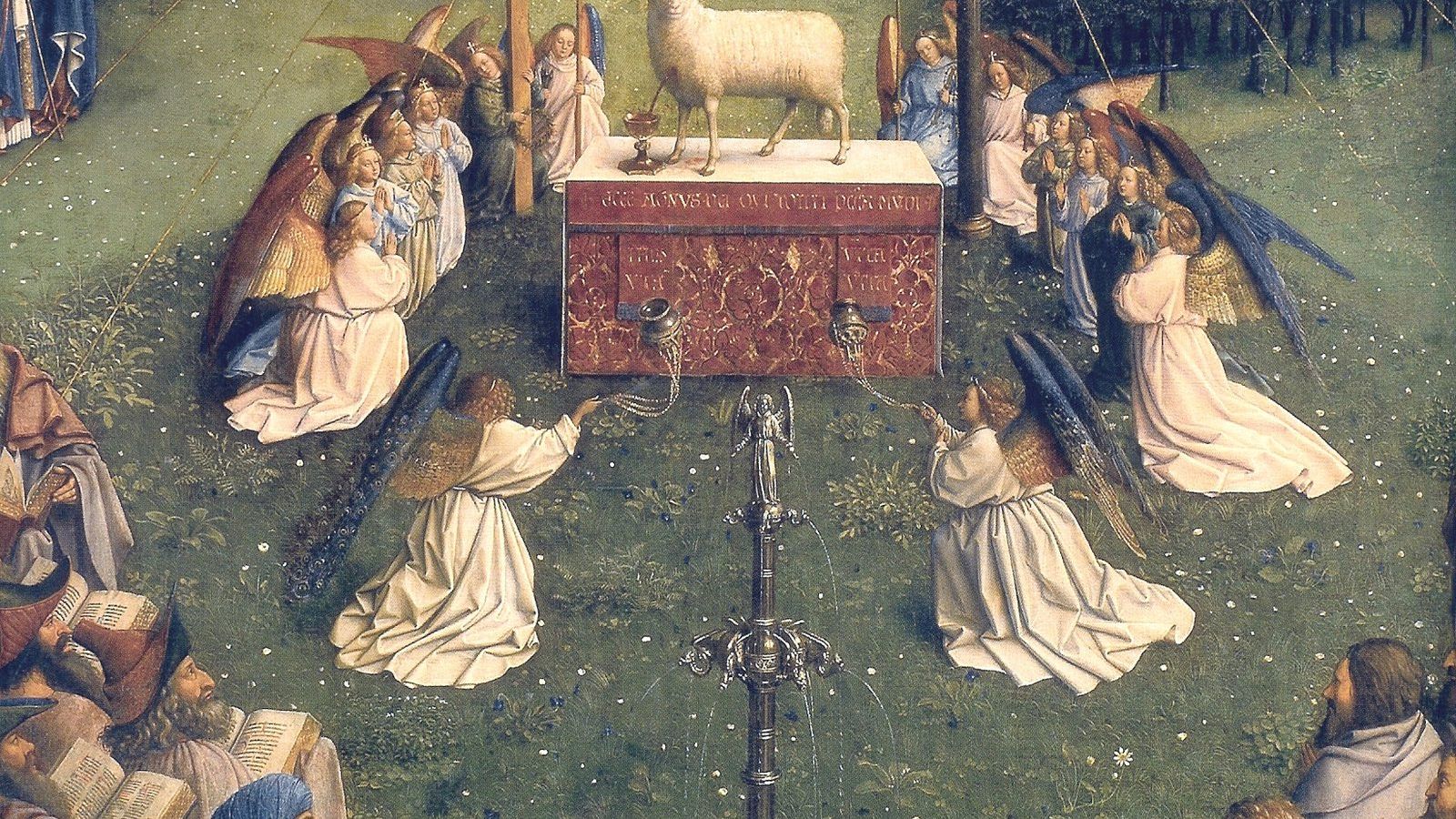
The Art History Masterclass reads this painting twice: in Unit 1, as the model of the four questions, and in Unit 5, among the works of Van Eyck and the painters of the Low Countries, with the Ghent Altarpiece and the technique of the oil glaze. The curriculum lists both units.