Oil Paint and the Northern Renaissance
The Low Countries around 1420 were rich cities with merchant and ducal patrons, and their painters built pictures in thin, translucent glazes of pigment bound in drying oil over a white ground. The unit explains how that technique works, with the refractive index and the arithmetic of a glaze, and what Van Eyck did and did not invent; then it reads the Ghent Altarpiece with its quatrain, its two states, and the restored face of the Lamb, and the Arnolfini Portrait with Panofsky's disguised symbolism and its limits. Rogier van der Weyden, Dürer's prints and the technology of woodcut and engraving, Bosch's Garden of Earthly Delights and the readings proposed for it, the Reformation's attack on images, and Bruegel's Hunters in the Snow complete the unit.
In the 1430s the painters of a few cities in the Low Countries learned to make a picture that could hold the gleam on a brass candlestick, the fur of a dog, and a whole room reflected in a mirror no wider than a hand. The method that made this possible, pigment bound in oil and laid in thin translucent layers over a white ground, remained the technique of European painting for five hundred years. This unit explains how it works and then follows it through three works that scholars still argue about, the Ghent Altarpiece, the Arnolfini Portrait, and the Garden of Earthly Delights, to the moment when the Reformation asked what a painting was for and Bruegel answered with a village in the snow.
1 The Low Countries around 1420
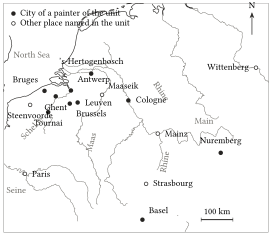
The painters of this unit worked in towns that lay within three days’ ride of each other (Figure 1). Bruges was a port, reached from the sea by the tidal inlet of the Zwin, and the northern base of the Italian trading houses; the Arnolfini family of Unit 1, merchants from Lucca, were among them. Ghent, a day to the east, lived from cloth and was the largest town of Flanders; Tournai, to the south, was a cathedral city of carvers and painters; Brussels, Leuven, and Antwerp lay in the duchy of Brabant, and Antwerp overtook Bruges only after 1500, when the Zwin silted up.
All of these towns but one had come, or were coming, under one ruler; Tournai remained a French royal city, an island in Burgundian land, until 1521. Philip the Good (1396-1467), duke of Burgundy from 1419, inherited Flanders and acquired Brabant, Holland, Zeeland, Hainaut, Namur, and Luxembourg one by one, so that by the 1440s a single court, the richest in Europe, moved between Brussels, Bruges, and Lille and governed most of what is now Belgium and the Netherlands. In 1425 Philip appointed as his painter a man from Maaseik on the Maas, Jan van Eyck (about 1390-1441), who travelled for the duke on missions whose purpose the accounts do not name, went to Portugal in 1428 to paint the duke’s future wife, and settled in Bruges, where he signed and dated a run of pictures between 1432 and 1439 and was buried there on 9 July 1441. He was not alone: in Tournai Robert Campin (about 1375-1444) ran the leading workshop from 1406, and his apprentice Rogier van der Weyden (about 1399-1464) was the official painter of the city of Brussels by 1436. Dukes and clergy ordered portraits and devotional panels, but the greatest works of the period were paid for by townspeople, such as an alderman (a member of the town council) of Ghent, a merchant from Lucca, a canon of Bruges, and the crossbowmen’s guild of Leuven, and the panels were made, as Unit 1 showed for the Arnolfini panel, on oak boards from the Baltic with a white ground of chalk and glue.