 Image: Claude Monet, public domain
Did Monet's cataracts change his colours?
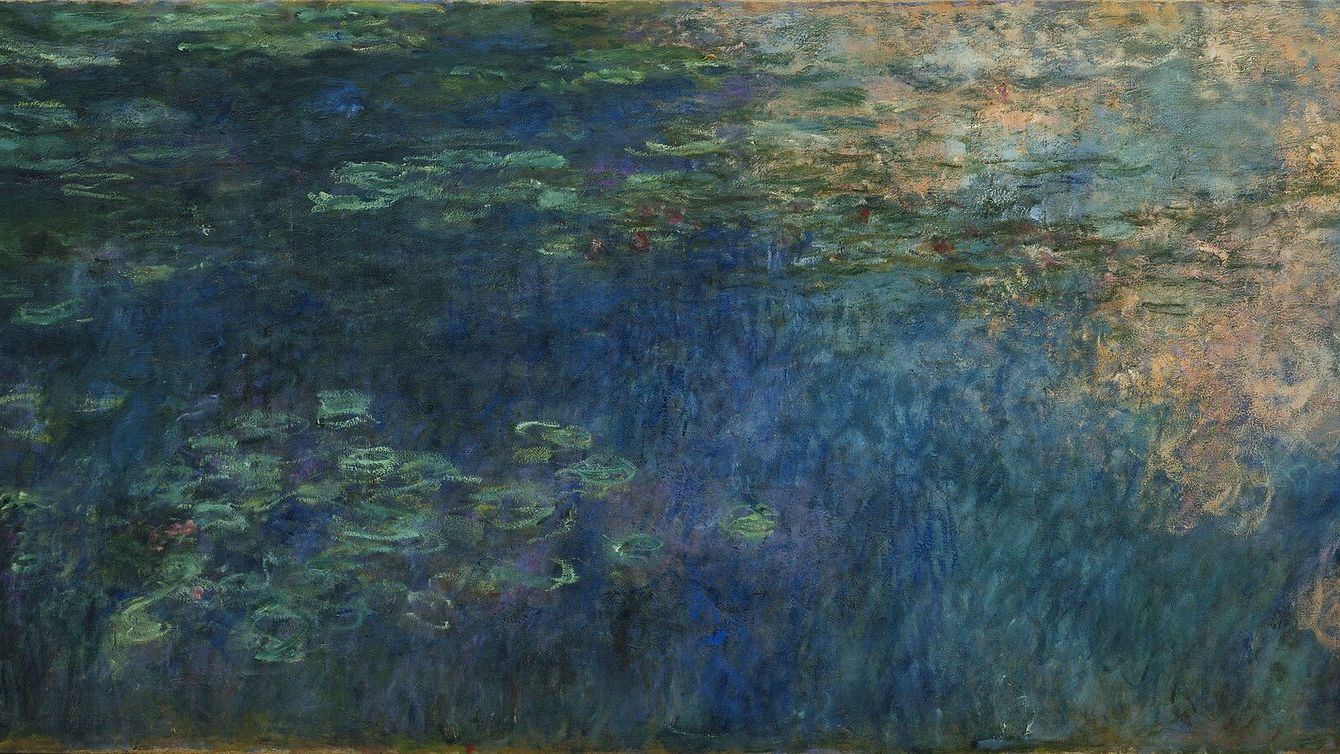
Claude Monet painted the pond in his garden at Giverny for the last thirty years of his life. The canvases of 1899 to 1905 show a Japanese bridge over water lilies in greens, pinks, and blues, with the sky reflected between the pads. The canvases of 1918 to 1922 show the same bridge in red, orange, and brown, the lilies lost in a thick weave of strokes, the forms hard to read. Monet was eighty, and he had cataracts. After an operation in 1923 he painted again, and the new pictures were cold and blue. The temptation to explain the late work by the eye is strong, and for once the medical record is good enough to test it.
The medical record
Monet was born in 1840. A Paris ophthalmologist diagnosed cataracts in both eyes in 1912, when he was seventy-one. He put off surgery for a decade, afraid, as he wrote to friends, that it would change his sight as it had changed the painter Mary Cassatt's. By 1922 his acuity in the better eye was about 20/200, which in most countries counts as legally blind: he could read the largest letter on the chart and little else. He complained that colours had gone dull, that reds looked muddy and blues were lost, and that he had to read the labels on his tubes of paint to know what he was using. In January and February 1923 the surgeon Charles Coutela removed the cataract from his right eye in two stages. He refused the second eye. Through 1923 and 1924 he complained of the opposite problem: everything was too blue, and then, with new corrective lenses, too yellow or too blue depending on which pair he wore. By 1925 he had settled with tinted lenses and was painting again, and he died in December 1926.
The simulation
Michael Marmor, a professor of ophthalmology at Stanford University, took the record and built it into pictures. A cataract is a clouding of the lens of the eye. As it thickens it scatters light, which blurs, and it yellows and browns, which filters out blue. Knowing Monet's acuity and the typical colour of a dense nuclear cataract, Marmor applied the equivalent blur and filter to photographs of the garden and to Monet's own earlier paintings, and published the results in 2006 and again in a free review article, Vision, eye disease, and art, in the journal Eye in 2016.
The simulated views are striking. Through a cataract at the level of 1922 the pond is an orange-brown haze in which blues have disappeared, greens have gone to olive, and forms have no edges. The late Japanese bridge paintings look like that haze. The match suggests that Monet painted what he saw, and that what he saw had lost its blue. After the operation the right eye, now without a lens, let through the ultraviolet and the deep blue that the old lens had blocked, which is the cyanopsia that patients report, and the paintings of 1923 and 1924 are correspondingly blue. The timeline fits the pictures.
What the simulation cannot settle
Marmor is careful, and Unit 7 of the masterclass follows his caution. Three things stand in the way of a clean verdict.
First, Monet knew what was happening. He wrote about it, read his paint labels, and chose which canvases to keep. He destroyed some late pictures and set others aside, and the ones that survive are partly his selection of what worked. A painter who knows his eyes are failing may paint from memory of colour as much as from sight, and the reds of the late bridges may be partly a decision.
Second, the late style has other causes. Monet had been loosening his handling for decades, and the large decorations of water lilies that he painted for the French state from 1914, now in the Orangerie in Paris, were conceived on a scale and at a viewing distance where detail would have been wrong. Some of what looks like lost sight is deliberate.
Third, pictures are poor evidence of disease. Marmor's review spends as much space on the cases that do not work as on Monet. The idea that El Greco elongated his figures because he was astigmatic has been repeated for a century and is wrong: an astigmatic painter sees the canvas with the same distortion as the world, so the distortion cancels. Degas, whose retinal disease is well documented and whose late pastels grow coarser year by year, is a better case than most, and even there the coarsening follows the style of the age as well as the retina. Diagnosing painters from paintings is, in Marmor's phrase, hazardous.
What the eye has to do with art history
The lesson of the unit is that vision is part of the painter's equipment and that equipment changes. The paint tube of 1841 made painting outdoors practical; the railway got the painters to the coast; Chevreul's theory of simultaneous contrast gave them a reason to put orange next to blue. The eye is one more tool, and like the others it has a history, a mechanism, and limits. Monet's late work can be read with the simulation beside it, and the reading is better for knowing what the simulation does and does not claim. The unit draws the eye in cross-section, shows what a cataract blurs and what a macular disease blurs, and offers an interactive in which you can look at a water lily painting of 1899 through the lens of 1922.
Seeing the pictures
The early and late versions of the Japanese bridge hang in museums on both sides of the Atlantic, and the Orangerie's oval rooms hold the great decorations, installed in 1927, the year after Monet died, as he had arranged them. Stand in the middle of one of the rooms and the question of his eyesight becomes less interesting than the question of what a painting of water with no horizon does to a viewer who is surrounded by it. That is a question about looking rather than about eyes, and it is the one the masterclass started with.
Unit 7 of the Art History Masterclass, Painting Modern Life, reads Monet's series and presents Michael Marmor's work as its research spotlight. The curriculum describes the unit, and a companion article on looking at a painting for an hour explains the method the unit builds on.