 Image: Tomwsulcer (CC0)
The physics of Jackson Pollock's pour
Pour honey from a spoon onto a plate and the falling thread does not land in a straight line. It coils, laying down loops in a neat spiral, because a viscous thread that hits a surface more slowly than it is falling has to go somewhere and buckles sideways. Physicists call it the liquid rope coiling instability, and it is the reason a child's drizzle of syrup looks the way it does. Jackson Pollock poured paint onto canvas for three years, from 1947 to 1950, and his lines mostly do not coil. The question of why was answered in 2019 by a team of fluid mechanicians with a syringe, a moving table, and a camera.
What Pollock did
In the barn behind his house at Springs, on Long Island, Pollock laid unstretched canvas on the floor, walked round and over it, and let paint fall from sticks, dried brushes, and the cans themselves. He used commercial enamel house paints, thinner than artists' oils, and he could pour a line, flick a spatter, or let a pool spread. The photographs and the film that Hans Namuth made of him at work in 1950 show the arm moving in long arcs a few tens of centimetres above the canvas, the whole body in motion, the paint arriving as a continuous thread. The technique was named dripping by the press, and Pollock disliked the word. He said he could control the flow, that there was no accident, and the critics were divided on whether to believe him.
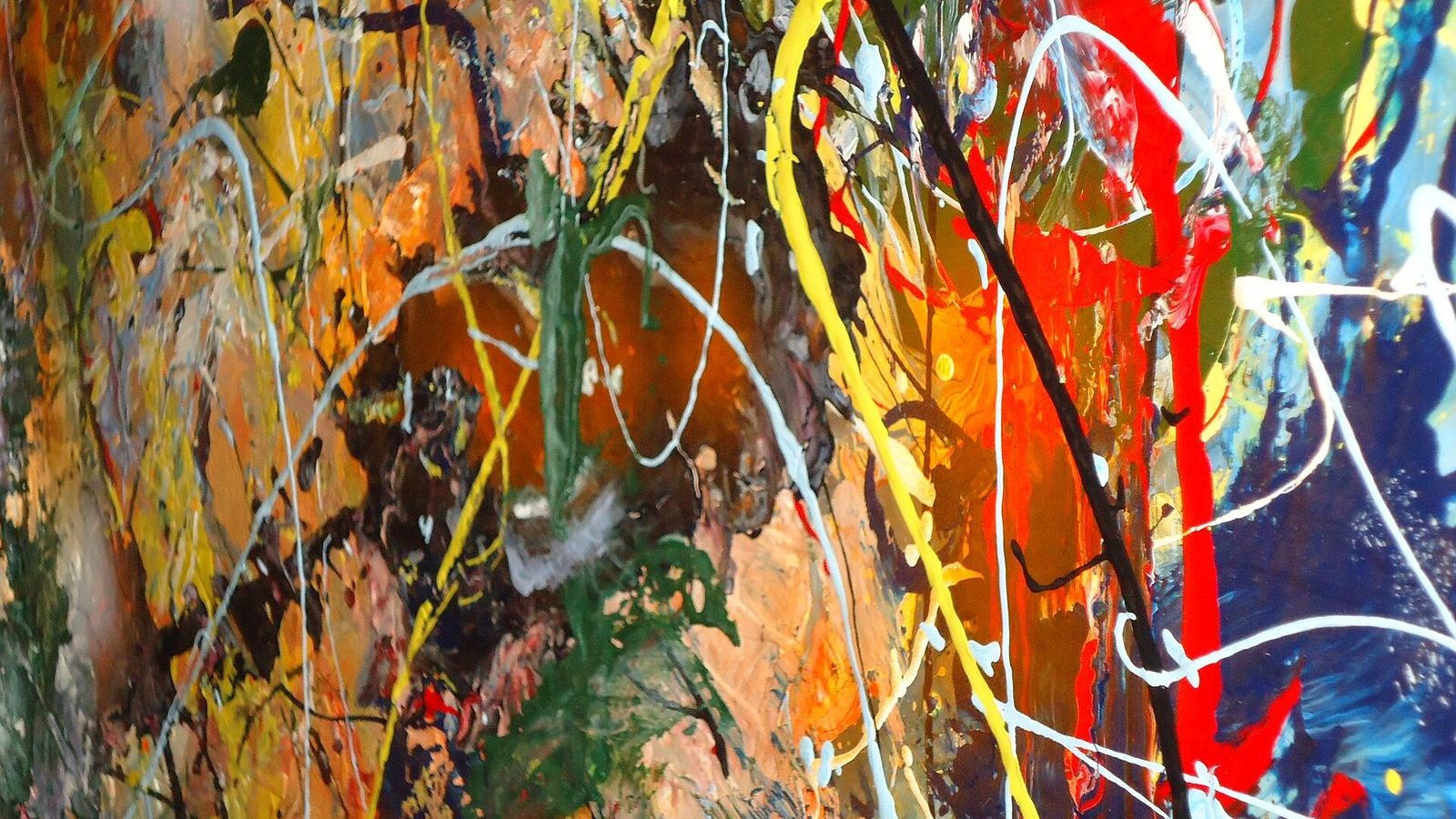
Most of the paintings cannot be reproduced here, because Pollock died in 1956 and his work is in copyright until the beginning of 2027; Autumn Rhythm (Number 30) of 1950, 267 by 526 cm, can be seen on the Metropolitan Museum's website, and Summertime: Number 9A of 1948 on Tate's. Look at the lines. They run in long curves, cross one another, thicken and thin, and only here and there do they loop.
The physics of a falling thread
A viscous liquid poured from a height forms a filament that accelerates under gravity as it falls. When it reaches the surface it must slow to the speed at which the surface, or the source, is moving. If that speed is less than the filament's speed at impact, the excess length has to go somewhere, and the filament buckles and coils. If the source moves across the surface faster than the filament is arriving, the thread is stretched out and lays down straight. Between the two there are regimes of waves and meanders that have been mapped by physicists in laboratories since the 1950s, with a scale of dimensionless numbers that depend on the viscosity of the liquid, the height of the fall, the diameter of the thread, and the speed of the source.
Roberto Zenit, a professor of engineering at Brown University, had studied the fluid dynamics of painting for years, first at the National Autonomous University of Mexico, where he worked with the painter David Alfaro Siqueiros's accidental-painting technique and the physics of brushstrokes. With Bernardo Palacios and colleagues, he built an apparatus: a syringe pump that pushes paint of known viscosity through a nozzle at a known rate, held at a known height above a table that moves beneath it at a known speed, and a high-speed camera. They poured, varied the speed and the height, and recorded where coiling began. Then they analysed Namuth's film frame by frame to estimate how fast Pollock's hand moved and how high above the canvas he held his stick.
What they found
The paper, Pollock avoided hydrodynamic instabilities to paint with his dripping technique, appeared in PLOS ONE in October 2019 and is free to read. The result is in the title. Pollock's hand speeds and pouring heights, as far as they can be recovered from the film, put him in the regime where a filament lays down straight, and the paintings show the straight regime. He moved fast enough and kept the source low enough that the thread never had time to coil. Where loops do appear in the paintings, they are at the ends of strokes, where the hand slowed, which is what the model predicts. The viscosity of the enamel paints he used, thinner than oils and thicker than water, put the threshold where a moving arm could stay above it.
The team's conclusion is modest and exact: the technique was a controlled pouring and not a dripping, and the control was physical, in the speed of the hand and the height of the source. Whether Pollock knew the physics is not the point. He had found the regime by practice and stayed in it.
What this does and does not explain
The physics explains the character of the line, which is the element of the paintings that is most often misdescribed. It says nothing about the composition, the layering of colours, the decision to stop, or the meaning, if any, of a surface covered in threads of paint from edge to edge. Earlier work by Richard Taylor and colleagues in 1999 measured the fractal dimension of Pollock's poured surfaces and found it rising year by year, which has been used in attribution disputes and also disputed. Unit 12 of the masterclass keeps the two kinds of claim apart. The coiling instability is a fact about paint. The judgement that the paintings are good is a judgement, and the unit gives you the vocabulary to make it rather than making it for you.
Trying it
You can test the regime in a kitchen. Pour honey or golden syrup from a spoon held still and watch it coil. Move the spoon slowly and the coils stretch into waves; move it faster and the thread lays down straight. Raise the spoon and the coiling returns at a higher speed. The unit includes an interactive in which you set the viscosity, the height, and the speed, and watch the thread land. Then look at a Pollock, in a museum if you can, and read the lines for the speed of the hand that made them.
Unit 12 of the Art History Masterclass, Art since 1945, presents Roberto Zenit's research as its research spotlight, draws the coiling and straight regimes in a diagram, and describes the paintings it cannot reproduce. The curriculum describes it.