

Painting Modern Life
For two centuries the Salon decided what Paris saw, and the unit begins with its rules and its numbers: how many works hung on the walls, how many people came, who judged. From David's Death of Marat to Courbet's pavilion of 1855, the unit follows the painters who fought the system, then the rebuilt city, Manet's Olympia, the eight exhibitions of the Impressionists, the paint tube, the railway, and the dealer. It ends with the painter's eye itself: Monet's series and his cataracts, Degas's failing sight, Seurat's dots, Van Gogh's letters, and the arrival of photography in 1839.
In the spring of 1876 the Paris Salon counted 518,892 visitors, which is more than the population of Lyon at the time, and 65,000 copies of its catalogue were sold. Two years earlier, a few streets away, thirty painters had borrowed a photographer’s former studio and attracted about 3,500 visitors in a month. The nineteenth century in Paris is the story of how the second kind of exhibition replaced the first as the place where painting changed, and the story is told here through institutions and numbers, through the city the painters walked in, and finally through the painters’ own eyes, which were tools like any other and could fail.
1 The Academy and the Salon
The Académie royale de peinture et de sculpture was founded in 1648, in the reign of Louis XIV (1638-1715), to raise painters and sculptors above the craft guilds, and in 1667 it held the first exhibition of its members’ work. From 1725 the exhibition was hung in the Salon Carré of the Louvre, and the room gave the event its name, the Salon. From 1737 it was held regularly, every year or every second year, and it was free to enter. In 1748 a jury of academicians began to decide what was hung, and in 1791 a decree of the Revolution opened the exhibition to every living artist, French or foreign, which turned a members’ show into the exhibition of the nation. With a few interruptions it remained the only place where a painter in France could be seen by the public and the state at once, until a decree of December 1880 handed it to a society of the artists themselves, the Société des Artistes Français, which ran it from 1881.
What hung there was governed by two rules, the jury and the ranking of subjects. The first, the jury, which until 1848 was made up of members of the Academy and which refused whatever it judged incompetent or improper. The second was the hierarchy of genres, the ranking of subjects that André Félibien (1619-1695) set out in 1667 and that Unit 6 states as a Principles box. History painting, which told a story from scripture, myth, or the past on a large canvas with many bodies, stood at the top; then came the portrait, the scene of daily life, the landscape, and at the bottom the still life. What matters for this unit is that the ranking was applied. The Academy’s school taught drawing from the nude because the history painter needed it, and the Prix de Rome, the scholarship that sent the best student to Rome for several years, was awarded for a history subject. The state bought history paintings, and the large formats were reserved by custom for history. A painter who chose a low genre was free to do so and earned less for it.
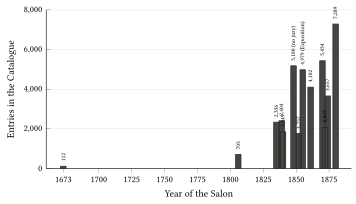
The numbers show what the system became. Figure 1 plots the number of entries in the Salon catalogue, the livret, in a series of years. The first exhibition with a printed catalogue, in 1673, listed 112 works. In 1806 there were 705 entries, by 1835 there were 2,336, and in 1848, the one year of the century in which the Revolution abolished the jury and everything submitted was hung, there were 5,180. The jury returned in 1849 and the count fell to 1,757 in 1852, then grew again to 4,102 in 1861, 5,434 in 1870, and 7,289 in 1880. The walls could not grow at the same rate, so pictures were hung from the floor to the ceiling in three or four rows. A painting placed high up near the ceiling was said to be “skied”, and nobody could make it out; a painting “on the line”, at eye level, had a chance. Visitors came in numbers that no museum of the time saw. In 1875 the Salon counted 496,000 visitors, of whom 139,000 paid the one-franc entry and the rest came on the free days; in 1876 the count was 518,892, with 185,000 paying. These figures were read out at the prize-giving and printed in the catalogue of 1877, because the state was proud of them.
The best way to feel the system is to open one catalogue, and the Salon of 1850 to 1851 is the one to open, because Gustave Courbet (1819-1877) chose it for his attack on the hierarchy.