 Image: Wassily Kandinsky, public domain
Who painted the first abstract picture?
For most of the twentieth century the answer was easy. Wassily Kandinsky, a Russian painter working in Munich, made the first abstract painting, a watercolour of loose coloured shapes with no subject, and he dated it 1910. The watercolour is in the Centre Pompidou in Paris. The story was told in Kandinsky's own writings, in Alfred Barr's chart of the development of modern art at the Museum of Modern Art in 1936, and in every survey since. Then the date was questioned, a Swedish painter's locked-away work came to light, and the question turned out to be two questions: what counts as abstract, and who gets to decide.
The watercolour dated 1910
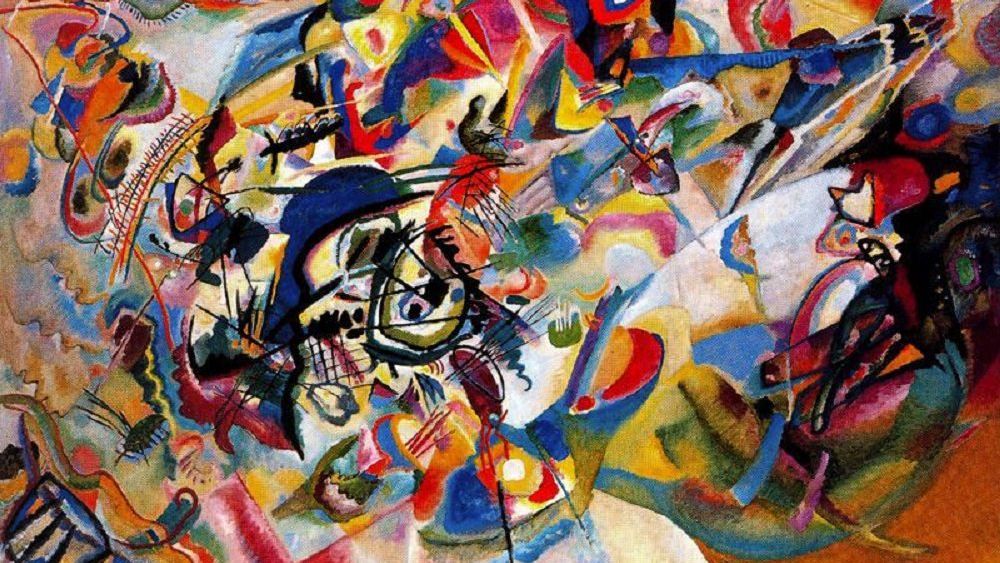
Kandinsky's Untitled watercolour, about 50 by 65 cm, carries the date 1910 in his hand. Scholars who have studied his work in sequence, among them the authors of the catalogue raisonné, think the date was added later and that the watercolour is a study for Composition VII, the three-metre canvas he painted in Munich in November 1913 and that now hangs in the Tretyakov Gallery in Moscow. Kandinsky had a reason to date it early. By the 1920s the priority of abstraction was contested, and he wanted the credit. His paintings of 1910 to 1912, the Improvisations and the first Compositions, still carry riders, mountains, and boats, dissolved almost to the point of disappearance and then no further. His book On the Spiritual in Art, published in December 1911 with the date 1912, argued that colour and form could work on the soul without a subject, as music does. The paintings caught up with the book in 1913.
Hilma af Klint, 1906
Hilma af Klint trained at the Royal Academy of Fine Arts in Stockholm and painted portraits and landscapes for a living. From 1906 she also painted something else. Working with a group of women who held séances and believed they received instructions from spirits, she produced the series she called Paintings for the Temple, 193 works made between 1906 and 1915, including, in 1907, The Ten Largest: ten canvases more than three metres high, in pink, orange, blue, and violet, covered in spirals, loops, letters, and botanical shapes. Nothing in them is a picture of anything. She showed them to almost nobody, and her will asked that they be kept from the public for twenty years after her death in 1944. The first large exhibition came in Los Angeles in 1986, and the retrospective at the Guggenheim Museum in New York in 2018 and 2019 became the most visited exhibition in the museum's history.
So the first abstract paintings were made in Stockholm in 1906, four years before the watercolour's doubtful date and seven before Composition VII. Or they were not, depending on what you need the word to mean.
The definitions
Abstract can mean three things, and the three give different winners.
If abstract means a picture that depicts nothing, af Klint wins by a decade, and so may others before her. Georgiana Houghton, an English spiritualist, drew tangles of coloured line in the 1860s that she called spirit drawings and exhibited in London in 1871. Decorative art has had no subject for as long as there has been decoration, which is why the word is usually narrowed.
If abstract means a painting made as a work of art, exhibited as such, and argued for in public as a new kind of picture, the Czech painter František Kupka has a strong claim. His Amorpha, Fugue in Two Colours, a large canvas of interlocking bands of red and blue, hung in the Salon d'Automne in Paris in October 1912, where critics mocked it and the public saw it. Kandinsky's works of 1913 follow. Af Klint, who exhibited nothing, is excluded by the definition rather than by the dates.
If abstract means the deliberate reduction of painting to its elements, Kazimir Malevich's Black Square, a black square on a white ground about 80 cm on a side, hung across the corner of the room like an icon at the exhibition called 0.10 in Petrograd in December 1915, is the first painting that makes the claim. Malevich dated it 1913 because the square had appeared in his stage designs that year. Historians date it 1915, the year the canvas was painted, and the Tretyakov's examination of it in 2015 found two earlier compositions beneath the square and an inscription that is still being argued over.
Why the dates were altered
Kandinsky backdated a watercolour and Malevich backdated a square because being first mattered to them, and it mattered because the story of modern art was being told as a race while they were still running it. Barr's chart of 1936 drew the movements as a flow diagram with arrows, and a painter who was not at the head of an arrow was in a footnote. Unit 8 of the masterclass treats this as evidence about the story rather than about the paintings. The artists' own dates are documents, and a document can be interested.
Af Klint's absence from the story has a different cause. She was a woman, she worked in Stockholm rather than in Paris or Munich, her paintings were made under spiritual instruction that the modernist account found embarrassing, and she had removed them from circulation herself. When they appeared, the canon had been written, and museums had to decide whether to rewrite it or to add a room. Most did the second. The question of who was first is in the end less interesting than the question of what the story did with the people who did not fit it, which is the subject of the second half of the unit.
What to look at
Put the pictures side by side rather than the dates. The Ten Largest are diagrams of a life, from childhood to old age, in a vocabulary of spirals and seed shapes that af Klint built from botany and from the diagrams of theosophy. Composition VII is a storm of colour whose underlying subjects, a deluge and a resurrection, Kandinsky wrote about and then hid. The Black Square is an argument about painting made with a ruler. They are not the same thing, and the word abstract covers all three only because the word is doing the work of a story.
Unit 8 of the Art History Masterclass, Modernism and the Story of Art, puts Kandinsky's and af Klint's paintings side by side with their dates, reads the Black Square at the 0.10 exhibition, and asks who has been left out of the story of art and why. The curriculum describes it.