

Art since 1945
Europe in ruins and the émigrés in New York open the unit, with the Museum of Modern Art's story of modern art and Greenberg's formalism. Abstract Expressionism follows: Pollock's pouring from 1947 and the physics of a falling thread of paint, Rothko's fields, de Kooning, Krasner and Mitchell, and Namuth's photographs of 1950. Europe answers with Dubuffet, CoBrA, Fontana, Klein, and Zero; Gutai in Japan and the Neoconcretists in Brazil show a story with more than one centre. Johns and Rauschenberg, Pop art in London and New York, and the Scull sale of 1973 lead to the point around 1965 to 1970 when objects, ideas, and bodies began to replace the canvas.
In 1939 the story of modern art that Unit 8 told still had one address, and it was Paris. By 1960 the critics who decided what counted were writing in New York, the pictures they wrote about were larger than a wall of a Paris flat, and a painter from Wyoming who had poured house paint onto canvas laid on the floor of a barn was the most famous artist in the world. This unit follows what happened to painting in the twenty-five years after the Second World War: how the centre moved and who moved it, what Pollock did with paint and what the physics of a falling thread says about his control of it, how Europe, Japan, and Brazil answered, how Pop art took its subject from the supermarket, and how, by the time a taxi-fleet owner sold fifty works of living artists at auction in 1973, the canvas itself had begun to lose its monopoly. Almost none of the works discussed here can be reproduced in a paid program, because their makers died after 1955 or are still living; the unit therefore describes them, gives their sizes and their museums, and links to the museums’ own pages, where the reader should keep a second window open.
1 1945 and the move to New York
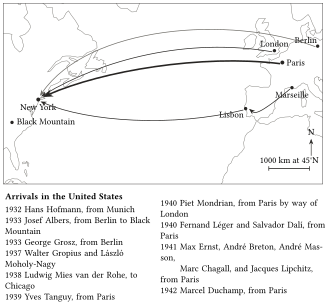
The war emptied Paris of the people who had made it the capital of modern art, and most of them went the same way (Figure 1). Some had left before the fighting began. Hans Hofmann (1880-1966), who had run a painting school in Munich, settled in the United States in 1932 and opened schools in New York and in Provincetown on Cape Cod, where a generation of younger Americans, Lee Krasner among them, learned from a man who had known Matisse and Picasso. Josef Albers (1888-1976) came from the closed Bauhaus in 1933 to teach at Black Mountain College in North Carolina. The painters of Paris followed when France fell in 1940: Piet Mondrian (1872-1944) arrived in New York in October 1940 by way of London, Fernand Léger (1881-1955) in the same year, Max Ernst (1891-1976), André Breton (1896-1966), André Masson (1896-1987), and Marc Chagall (1887-1985) in 1941, most of them helped out of Marseille by the American rescue worker Varian Fry, and Marcel Duchamp (1887-1968) in 1942. For a few years the leaders of Surrealism and of geometric abstraction lived within a few streets of one another in Manhattan, and the young Americans who would matter after the war could watch them at openings, in bars, and in the one gallery that showed them all.
That gallery belonged to Peggy Guggenheim (1898-1979), a collector who had bought a picture a day in Paris in the winter of 1939 to 1940, left Europe in the summer of 1941 with Max Ernst, whom she married at the end of that year, and in October 1942 opened Art of This Century on West 57th Street, a gallery with curved walls and pictures hung on arms away from the wall. She showed the Europeans, and she gave a contract and, in November 1943, a first solo exhibition to a thirty-one-year-old painter from Wyoming named Jackson Pollock, for whose apartment hallway she commissioned a mural six metres long. When she closed the gallery in 1947 and moved to Venice, the New York painters she had shown no longer needed her.
The ground for all this had been prepared by the Museum of Modern Art, New York (MoMA), which opened in November 1929 with Alfred H. Barr Jr. (1902-1981), aged twenty-seven, as its first director, and Barr did something no museum had done before: he told the history of modern art as a single connected story and built a collection to illustrate it. On the dust jacket of the catalogue of his exhibition Cubism and Abstract Art of 1936 he printed a chart, a diagram of arrows running from Cézanne, Van Gogh, Gauguin, and Seurat at the top through Fauvism, Cubism, Futurism, and the other movements to two boxes at the bottom labelled geometrical and non-geometrical abstract art. The chart put abstraction at the end of the line, as the place the story was heading, and it put the museum that owned the chart in charge of saying who was in it. Unit 11 described what a museum does to the works it holds; Barr’s museum also decided which story the works told, and by 1945 the story’s last chapter was waiting for American names.
The critic who supplied the argument was Clement Greenberg (1909-1994). In an essay of 1939 in the magazine Partisan Review, “Avant-Garde and Kitsch”, he argued that serious art had to keep moving away from the mass-produced culture of the market, and in later essays, above all “American-Type Painting” of 1955 and “Modernist Painting” of 1960, he made the argument about painting specific. Each art, he wrote, should concentrate on what belongs to it alone; what belongs to painting alone is the flat surface, so the history of modern painting is the history of its growing acknowledgement of flatness, which means that painters stopped pretending that the canvas was a window onto a space behind it and let it be seen as a flat surface with paint on it, from Manet through Cézanne and Cubism to the Americans of his own day. This position is called formalism, because it judges a work by its form, by how the surface is organized, rather than by its subject or its story, and it gave the New York painters a history that ended with them. Greenberg championed Pollock from his first exhibitions, and his authority in the 1950s was such that painters changed what they did on his advice. The counter-arguments came later and are part of the tier above this one; here it is enough to know that the story of flatness was one critic’s story, told very well, and that the next section’s painters did not all believe it.