 Image: Luu (public domain)
Why there are several hundred biennials
On 19 April 1893 the city council of Venice resolved to hold an exhibition of art every second year, in honour of the silver wedding of King Umberto and Queen Margherita of Italy. The mayor, the poet Riccardo Selvatico, turned the idea into an international show with the politician Antonio Fradeletto and the philosopher Giovanni Bordiga, a pavilion was built in the public gardens at the eastern end of the city in 1894, and the first Esposizione Internazionale d'Arte opened on 30 April 1895. More than 200,000 people came. The word biennale, Italian for an event held every second year, has since become the name of a form, and the usual estimate for the number of such exhibitions in the world today is several hundred. Nobody keeps a full count. This post follows the form from the gardens of Venice to Kassel, Havana, Gwangju, and Kochi, and asks what each city wanted from it.
A festival with a sales office
The historian Caroline A. Jones of the Massachusetts Institute of Technology, whose research Unit 15 of the masterclass presents, read the founding documents in the Biennale's archive and found that the first poster promised, under the exhibition's name, serenades, regattas, sporting contests, illuminations, concerts, a fencing tournament, and fireworks. The exhibition also kept a sales office, which took a share of every sale made from its walls and used it to pay for the next edition, until the office was closed for good in 1973. Jones's name for this inheritance is the event structure, and she traces it to the world's fairs of the nineteenth century. A biennial, in her account, is an exhibition built as an event. It recurs on a fixed rhythm, it has an opening week and a closing day, it sorts art by nation or by a curator's theme, and it surrounds the works with prizes, parties, and travel. Her paper of 2020 in OBOE Journal is free to read.
The gardens as a map
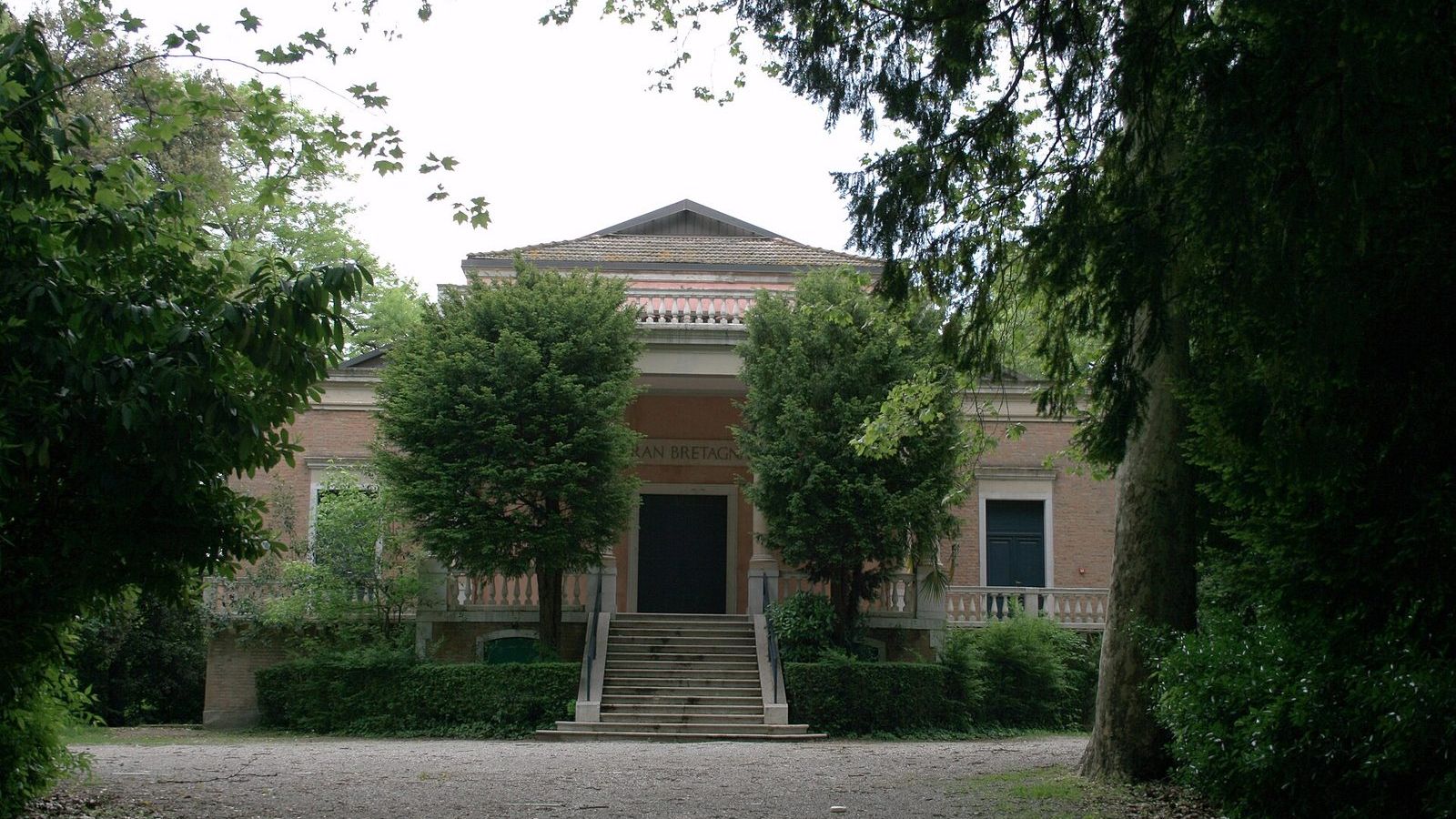
The Giardini, laid out between 1808 and 1812 when Venice belonged to Napoleon's Kingdom of Italy, began to fill with small national buildings when Belgium built the first foreign pavilion in 1907. Great Britain, Germany, and Hungary built theirs in 1909, France in 1912, and Russia in 1914. The photograph above shows the British pavilion, opened in 1909 to a design by Edwin Alfred Rickards, at the top of its steps among the trees. By 1964 almost every space was taken, Korea's pavilion of 1995 was the last to be fitted in, and the Giardini today hold the Central Pavilion and 29 national pavilions. The plan is a map of a century of diplomacy. The first builders were the great powers of Europe before the First World War, and they took the best sites; the 1930s added the United States and the smaller states of Europe; the 1950s added Israel, Switzerland, Venezuela, Japan, Finland, and Canada; Brazil's pavilion of 1964 is the only one from South America, and no African or South Asian state has a building there. Countries without a pavilion rent rooms in the Arsenale, the old shipyard of the Republic, or palaces in the city. The Biennale's own history gives the dates, and the Biennale of 2026 counted 100 national participations, 29 of them in the Giardini, 25 in the Arsenale, and 46 in buildings around Venice.
Kassel, and the curator as author
The second model came from a bombed city. Kassel's Fridericianum, one of the first public museums on the European mainland, had burnt out in the air raids of 1943 and 1944, and in 1955 the painter and teacher Arnold Bode filled its roughly patched rooms with the modern art that Germany had been forbidden to see since 1937. From 16 July to 18 September 1955 he showed 670 works by 148 artists, and 130,000 people came to what he called a museum of one hundred days. documenta, written with a small d, has been held in Kassel ever since, and its fifth edition, in 1972, changed the form. Harald Szeemann put 222 artists into sections of his own devising under the title Questioning Reality, Image Worlds Today, several of the invited artists signed a letter of protest against being used as illustrations of a curator's idea, and every large curated exhibition since has had to answer that letter. From documenta 5 the person who selects and arranges the show has been read as its author, with a title, a thesis, and a catalogue essay.
documenta 11 of 2002, directed by Okwui Enwezor, held four conferences in Vienna and Berlin, New Delhi, St Lucia, and Lagos before the exhibition opened in Kassel, so that the show was the fifth platform of an argument begun around the world. documenta 13 of 2012 drew 904,992 visitors, seven times the number of 1955.
Havana redraws the map
Until the 1970s the recurring exhibitions of contemporary art could be listed in a sentence: Venice, the Carnegie International in Pittsburgh from 1896, the Whitney Museum's surveys in New York from 1932, São Paulo from 1951, documenta from 1955, and the Biennale de Paris for artists under thirty-five from 1959. All of them were in Europe or the Americas, and all took the map of the art world as given, with its centre in Paris or New York. The exhibition that changed the map was founded in 1984 in Havana. The Bienal de La Habana, organized by the Wifredo Lam Centre of Contemporary Art, showed in its first edition only artists of Latin America and the Caribbean, widened its invitation in 1986 to Africa, Asia, and the Middle East, and in its third edition of 1989 became the first large exhibition made by curators of the global South for artists of the global South.
The 1990s then did what the 1890s had done, everywhere at once. Istanbul had begun in 1987 and from 1992 gave each edition to a single invited curator. Dakar held its first visual arts edition in 1992, Sharjah began in 1993, and Johannesburg held a biennial in 1995, the year after the end of apartheid, and a second in 1997 that the city council closed early when it withdrew its money. Gwangju in South Korea opened in September 1995, in the city where the army had crushed a pro-democracy uprising in May 1980, and became the largest biennial in Asia. Of the forty-three biennials and triennials that the unit plots on a map by the year of their first edition, fifteen began in the 1990s. The Kochi-Muziris Biennale in Kerala, founded by the artists Bose Krishnamachari and Riyas Komu, opened on 12 December 2012 in the warehouses of Fort Kochi as the first biennial in India.
What a city wants from a biennial
The reasons are on record, because the founders stated them. Artists of the global South could be seen first at home, on their own terms and in their own company, and curators from those regions could set the questions; the unit calls this the counter-map. Cities that had lost their industry wanted visitors, and Liverpool, Gwangju, and Istanbul each said so. A new state or a new government wanted a place in the circle that may speak at Venice, which is what a national pavilion has claimed since 1907. And the form is cheap to start, because a biennial owns nothing. It borrows buildings and borrows works, and it can host a performance, a meal, or a conversation for a season without having to keep anything afterwards, which is why the relational art of the 1990s found its habitat there. What the new biennials inherited whole was the event structure of the old ones, the opening week, the prizes, the parties, and the travel.
The numbers now
The 60th International Art Exhibition in Venice, curated by Adriano Pedrosa under the title Foreigners Everywhere, was open from 20 April to 24 November 2024, which is 219 days, and sold 699,304 tickets, about 3,200 a day. The Biennale's closing release says that 59 per cent of the visitors came from abroad and that a further 27,966 people came in the three preview days. The 2026 edition, three weeks shorter, counted 714,015 visitors including its previews. The complaints about the circuit are as old as the circuit. The same curators, artists, and collectors travel from one opening to the next. The travel has a cost that several biennials now publish as a carbon footprint. The unit keeps the complaints beside the counter-map, because both describe the same form.
Unit 15 of the Art History Masterclass, Biennials and a Global Art World, draws the plan of the Giardini with the date of every pavilion, plots the forty-three biennials by the decade of their first edition, reads the Biennale of 2024 from its own closing figures, and presents Caroline A. Jones's research as its spotlight. The curriculum describes it.