 Image: Andrew Russeth (CC BY-SA 2.0)
736 hours in a chair
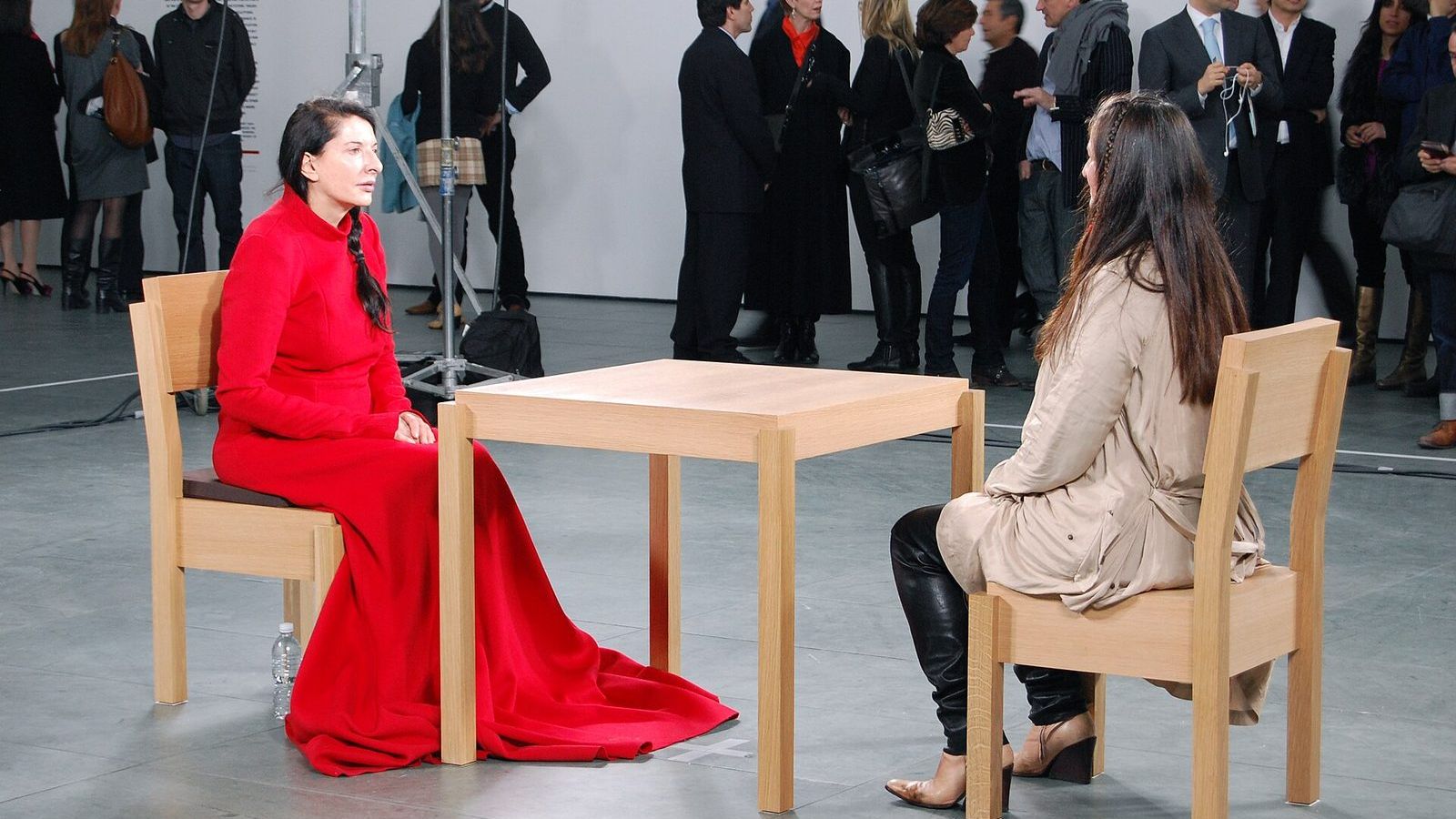
The rules were short. From 14 March to 31 May 2010, on every day the Museum of Modern Art in New York was open, Marina Abramović sat on a wooden chair in the museum's atrium, in a long dress of a single colour, with an empty chair facing her and, for the first weeks, a wooden table between the two. Visitors could enter the lit square one at a time, sit on the empty chair for as long as they wished, and look at her. They were not to speak, to touch, or to bring anything with them. She looked back, lowered her eyes when a sitter stood up, raised them for the next, and did not eat, drink, or leave the chair during the museum's hours. The photograph above was taken in the first days, in the red dress and with the table still in place.
The numbers
Over the eleven weeks the performance totalled, by the museum's count, 736 hours and 30 minutes. Unit 14 of the masterclass draws that figure on a grid of a year's 8,760 hours, where it covers a little more than a month of continuous time. The photographer Marco Anelli made a portrait of every person who sat down, and his count, published as a book, is 1,545 sitters, some of whom stayed a minute and some a whole day. How many people came to watch is given variously as more than 700,000 and as about 850,000, and the unit reports the range rather than choosing between the figures. In the last weeks a queue formed outside the museum before it opened, and some of the people in it had been there since the night before.
Partway through the run, by her own account, Abramović had the table removed. The change is small on paper and large in the room. The table had set a distance and given the sitter something to put their hands on; without it there was only the floor between two chairs, and the one rule that remained was the gaze.
What else was in the building
The atrium was one part of a retrospective of about fifty works from four decades, and upstairs the museum did something it had rarely done before. Trained performers, in shifts, re-performed five of Abramović's works of the 1970s, among them Imponderabilia of 1977, in which two naked people stand facing each other in a doorway so narrow that every visitor has to squeeze between them and decide which of the two to face. The original was made with Ulay, the German artist Frank Uwe Laysiepen, with whom she worked from 1976 for twelve years. Their last work together, The Lovers of 1988, was a walk towards each other from the two ends of the Great Wall of China that lasted ninety days and ended with a meeting on 27 June 1988 and a parting. A visitor in 2010 therefore met her work in three forms at once, the artist herself in a chair, other bodies performing her instructions, and photographs, videos, and relics in cases, and the question of which of the three was the work is the question the unit asks.
Where the form came from
Abramović's earlier work had put her body at risk in front of witnesses. In Rhythm 0, at the Studio Morra in Naples in 1974, she stood for six hours, from eight in the evening until two in the morning, beside a table of seventy-two objects, from a rose and a feather to a scalpel, a gun, and a bullet, next to a printed text that said the objects could be used on her as desired and that she took full responsibility. The performances of about 1969 to 1975, by Vito Acconci, Chris Burden, Gina Pane, Ana Mendieta, and others, made pain, exposure, or endurance undergone in real time the content of the work, before people who were forbidden to help or invited to harm. The Artist Is Present belongs to that line and reverses one thing in it. Nothing was done to her; the demand was time, and whoever sat down shared it for as long as they could.
What is left when it is over
The question the unit asks of every performance is what remains. Two answers have been argued for thirty years. The theatre scholar Peggy Phelan wrote in 1993 that performance lives only in the present and that anything saved, recorded, or documented is something other than the performance. The art historian Amelia Jones, now at the University of Southern California, replied in 1997 in a paper in Art Journal called "Presence" in Absentia, in which she admitted that she had not been in the room for most of the performances she wrote about and argued that this did not disqualify her, because the event and its documents need each other. The event needs the record to be known to have happened, and the record needs the event to be more than a picture or a text. On her account the person who was in the room has no privileged access to the meaning of the work. The performance scholar Philip Auslander added a distinction in 2006 between documentary records, which show something that happened, and theatrical ones, which were staged for the camera, and the first duty of anyone reading a photograph of a performance is to ask which kind is in front of them.
Apply the two answers to the atrium. Phelan's says that to sit opposite Abramović was to be present at something that would not happen again, and the queue outside the museum agreed with her. Jones's says that most of the sitters knew the work from its documents before they came, that for many of them the point was to have sat, and that Anelli's portraits were the form in which they would keep it, which is a fact about a record rather than about an experience. Both are true of the same eleven weeks. The unit's reading ends with a sentence that holds them together: the work was a rule, two chairs, and 736 hours and 30 minutes, and its content was supplied by 1,545 strangers who agreed to be looked at in public by a woman who would not look away.
What a museum buys
Museums have since worked out how to own such things. In 2005 Tate bought Tino Sehgal's This Is Propaganda orally, with the conditions recited from memory in front of lawyers and nothing written down, one of the first two live works the museum acquired. What a museum acquires when it buys a performance is a licence to re-perform it under stated conditions, together with the score or the instructions, the documentation that exists, and whatever relics the work produced. It owns a right and a set of records, and no object. Two questions stay open, and the unit leaves them open. When Imponderabilia is performed by two dancers in 2030, is what the visitor squeezes between the work of 1977, a new work, or the exhibition of a document? And when the artist who sat for 736 hours is gone and her chair is given to another, what is lost, and to whom?
Unit 14 of the Art History Masterclass, Performance and the Body, reads The Artist Is Present beside Rhythm 0, Allan Kaprow's happenings, Chris Burden's Shoot, and Tehching Hsieh's year of punching a time clock, and presents Amelia Jones's research as its spotlight. The curriculum describes it.