 Image: Joyofmuseums (CC BY-SA 4.0)
Were Greek statues white?
Walk through the Greek galleries of any large museum and the sculpture is white, or the yellowish grey that white marble becomes. The museums' lighting is designed for it, the plaster casts that art schools drew from for two centuries copied it, and the neoclassical buildings of every capital in Europe and America imitate it. It is a modern taste. The Greeks painted their statues, and so did the Romans, and for most of the last two hundred years the evidence sat in plain sight, in flakes of colour that the eye could just make out and the museums preferred not to mention.
What the eye can see
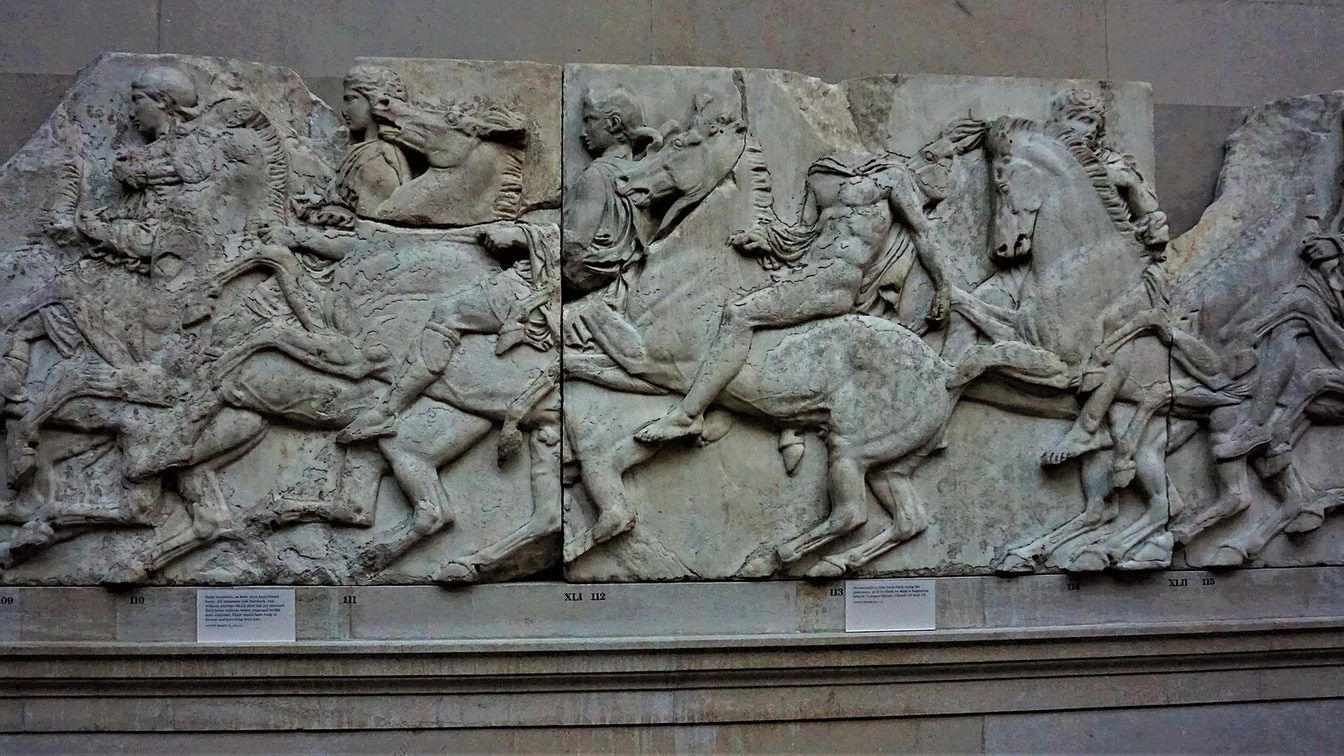
The Archaic statues of the sixth century BC kept the most paint, because many of them were buried early. The Peplos Kore on the Acropolis in Athens, carved about 530 BC, has red on her hair and traces of a painted pattern on her dress. Kouroi have hair painted dark, lips and nipples red, and eyes with painted irises. On the Parthenon, finished in 432 BC, the first excavators and visitors of the early nineteenth century reported blue backgrounds behind the sculpted figures of the frieze. The taste for whiteness ignored all this. Johann Joachim Winckelmann, whose History of the Art of Antiquity of 1764 founded the discipline, wrote that the whiter a body is, the more beautiful it is, and he had seen mostly Roman marble copies in Rome, scrubbed by collectors. His authority and the collectors' scrubbing made the white statue the Greek statue for everyone who came after.
Even the British Museum's own Parthenon sculptures were cleaned to make them whiter. In 1937 and 1938, while a new gallery paid for by the dealer Lord Duveen was being built, workmen used copper tools and abrasives on some of the marbles and removed part of their surface along with the patina, an episode the museum later acknowledged in full.
A pigment that glows
The modern proof came from a method rather than from new fragments. Egyptian blue is a synthetic pigment, calcium copper silicate, made by heating sand, lime, and copper to about 900 degrees. The Egyptians invented it around 2500 BC, and it was the standard blue of the Mediterranean world until the end of antiquity. In 2009 Giovanni Verri, then at the British Museum and now a conservation scientist at the Art Institute of Chicago, published a way of finding it. When Egyptian blue is lit with ordinary red light, it emits light in the near infrared, at wavelengths around 910 nanometres, which a modified camera can record. The glow is so strong that a single grain of the pigment shows as a bright point even where the eye sees nothing. The method is called visible-induced luminescence imaging, and it needs no sample and no contact.
Since then it has been used on wall paintings, mummy portraits, and statues across the world's museums, and the map of ancient blue has grown every year. Egyptian blue turns up on the Alexander Sarcophagus in Istanbul, on the terracotta army in China, and on Roman portraits in Copenhagen.
The Parthenon sculptures in 2023
In 2023 Verri and colleagues from the British Museum and King's College London published The goddess' new clothes in the journal Antiquity, an open access study of the carving and colour of the Parthenon sculptures in London. They imaged the pediment figures, the metopes, and the frieze and found Egyptian blue in many places: on the backgrounds, on the drapery of the goddesses from the east pediment, on the water from which a figure rises, and in patterns on garments. They also found traces of a purple, which analysis showed had not been made from the shellfish dye that the ancient world prized, and of white pigments that would have given the marble a painted skin rather than a bare one.
The paper's other finding concerned the carving. The surfaces under the paint were finished with the same care as the surfaces that were never painted, with no roughening to make the paint hold. The sculptors carved folds that only paint would make visible from the ground, and they painted a garment with the same attention they had given to carving it. The colour was part of the design, applied by the same workshop, and the marble was a support for it in the way a panel is a support for a painting.
Why the whiteness was made
Unit 2 of the masterclass treats this as a lesson about evidence and about taste. The evidence for colour was always there; the taste for white marble filtered it out for two centuries. The filter had a history: Winckelmann's theory, the Roman copies that reached collectors first, the plaster casts that reproduced form and not colour, the neoclassical architecture that borrowed the form, and the cleaning that removed what colour was left. When reconstructions of painted statues began to tour in exhibitions after 2003, under the title Gods in Color, many visitors found them garish. That reaction is itself historical. It is what two hundred years of white marble does to an eye.
What the colours were like
Reconstructions are arguments, and the scientists who make them say so. The pigments found by imaging and sampling give the palette: Egyptian blue, red and yellow ochre, cinnabar, malachite green, a purple from plants, carbon black, lead and bone white. What they do not give is the exact tone, the shading, or the finish, which have gone. A painted kore probably looked less like a toy and more like a polychrome wooden saint in a Spanish church: strong colour, patterned borders, gilded details, and skin tones that read as skin. The eyes, with painted irises and dark lashes, would have looked back.
The British Museum's Parthenon gallery now explains the paint to visitors. Whether the sculptures should be in London at all is a separate question, which the masterclass takes up in Unit 11 on museums and restitution, where the firman of 1801 and the purchase by Parliament in 1816 are read as documents. In Unit 2 the question is what the Greeks made, and the answer is a painted building with painted statues, standing in strong sun, whose white is ours and not theirs.
Unit 2 of the Art History Masterclass presents Giovanni Verri's imaging as its research spotlight, with a table of which pigments were found where. The curriculum describes the unit.