 Image: Masaccio, public domain
How Alberti's perspective works, with a ruler
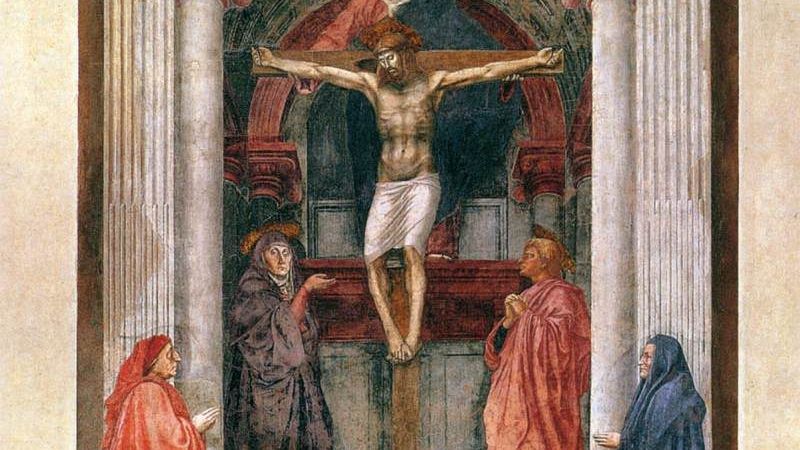
The fresco of the Trinity that Masaccio painted in Santa Maria Novella in Florence about 1427 shows a barrel-vaulted chapel that is not there. The wall is flat. The chapel, with its coffered ceiling receding into the dark, its Ionic columns, and its two donors kneeling on a step in front, is paint. Visitors in the fifteenth century are said to have thought the wall had been cut through. The illusion rests on a geometric construction that Leon Battista Alberti wrote down eight years later in his treatise On Painting, and it can be drawn with a ruler on a sheet of paper in ten minutes. Here is how.
The window
Alberti's idea is that a picture is a window. The painter stands at a fixed point and looks through a transparent plane at the world; the picture records where the lines of sight pass through the plane. Everything follows from three facts of geometry. Lines that run straight away from the viewer, at right angles to the picture plane, all converge on one point on the picture, which is at the height of the viewer's eye. Lines parallel to the picture plane stay parallel. And equal distances receding into depth appear smaller and smaller, in a ratio that can be worked out.
The construction, step by step
Take a sheet of paper and draw a rectangle for the picture. The floor you are going to build is paved with square tiles, like a Florentine church floor, because tiles make the geometry visible.
- Draw a horizontal line across the rectangle at the height of the eye. Alberti says the height of a standing person, about three Florentine braccia, which is around 175 cm. This is the horizon line.
- Mark a point on it, usually near the middle. This is the centric point, which we now call the vanishing point.
- Divide the bottom edge of the rectangle into equal parts, each the width of one tile. Alberti used the braccio as his unit, so that the figures in the picture can be measured against the floor.
- Draw a line from each division on the bottom edge to the vanishing point. These are the orthogonals, the edges of the tiles that run away from you. The floor now has its long lines but no depth.
- For the depth, mark a second point on the horizon line, to one side, at a distance from the vanishing point equal to the distance at which the viewer stands from the picture, in the same scale. This is the distance point.
- Draw a line from the bottom corner of the rectangle on the opposite side to the distance point. Where this diagonal crosses each orthogonal, draw a horizontal line across the floor. These are the transversals, the near and far edges of each row of tiles.
The floor is finished. Each row of tiles is shallower than the one in front of it, in exactly the ratio that a real floor would show from that eye height and that distance. Anything standing on the floor can now be measured: a figure whose feet are on the fourth transversal has a known position in depth, and its height can be taken from the braccia marked on the bottom edge and scaled along the orthogonals.
Why the diagonal works
The diagonal is the clever part. On a real tiled floor, the diagonal of a square tile makes 45 degrees with the picture plane, and all 45-degree lines converge on a point on the horizon that lies one viewing distance to the side of the vanishing point. So a line from the corner of the first tile to the distance point is the diagonal of every tile in that row, and it crosses the orthogonals exactly where the tiles' far edges fall. The construction uses one line to do what would otherwise need a calculation for each row.
The calculation is not hard, and it is worth seeing once. If the eye is at height h above the floor and the viewer stands at distance d from the picture plane, a point on the floor at distance z beyond the plane appears on the picture at a height h·z/(d+z) above the bottom edge. For tiles one unit deep and a viewer four units back, the far edges of the first rows sit at h/5, 2h/6, 3h/7, and 4h/8 of the eye height, which is a fifth, a third, three sevenths, and a half. Each row is shallower than the last, and the rows pile up towards the horizon without ever reaching it.
Brunelleschi's demonstration
Alberti wrote the rules down, but the method was in use before him. His own book is dedicated to Filippo Brunelleschi, and Brunelleschi's biographer Antonio Manetti describes a demonstration from the 1410s or 1420s: a small panel painted with the Baptistery of Florence as seen from the cathedral door, with a hole drilled at the vanishing point. The viewer held the panel with the painted side facing away, looked through the hole, and held up a mirror; the reflected painting matched the real Baptistery behind it. The panel is lost, and the exact method is argued over, but the test is the right one. A perspective construction is correct if, seen from the right point, it coincides with the thing.
Reconstructing the Trinity
Masaccio's fresco is the first large painting in which the construction can be checked, and generations of students have checked it. Extend the lines of the coffers in the vault and they meet at a point at the foot of the cross, on the step on which the donors kneel, about 175 cm above the floor of the church, which is the eye height of a standing adult. The coffers shrink in depth in the proper ratio, so that the chapel reads as about as deep as it is wide. The capitals of the columns, the mouldings, and the step all obey the same point. Masaccio had the vanishing point on the wall before he painted a figure, and the figures were fitted to the space rather than the space to them, which is the reversal that Unit 4 of the masterclass calls the beginning of the Renaissance picture.
There is one liberty. God the Father, who stands behind the cross and holds it up, is drawn as if seen from in front, not from below, where a viewer standing at the right point would be. Masaccio knew that a correctly foreshortened God would look wrong, and he broke the rule where the rule would have hurt the picture. Perspective was a tool from the first day, and the best painters used it as one.
What it changed
A tiled floor sounds like a small thing. It made pictures measurable. A painter could place a figure at a known distance, a patron could ask for a chapel of a given size, and a viewer standing in front of the picture occupied a definite point in the space it opened. Paintings of the next two centuries, from Raphael's School of Athens to Vermeer's rooms, are variations on the window, and the camera, when it came, was a window with a lens. Try the construction once with a ruler and the floor of every Renaissance painting you see afterwards will show you where the painter stood.
Unit 4 of the Art History Masterclass draws Alberti's construction in a Principles box, overlays it on Masaccio's Trinity, and offers an interactive perspective box in which you move the eye and watch the floor change. The curriculum describes the unit; a companion article explains what a painter's contract of the same century says about the price of blue.