 Image: Zhang Zeduan, public domain
How to unroll a Chinese handscroll
In a Western museum a painting hangs on a wall and you see all of it at once. A Chinese handscroll is kept rolled in a box and seen by one or two people at a table, who unroll it from the right with one hand while rolling up what they have seen with the other, so that at any moment a section about the width of their shoulders is open. The picture is not a surface. It is a journey with a speed, and the viewer controls the speed. The format explains a great deal about Chinese painting that a reproduction in a book cannot, because the book shows the whole scroll and the whole scroll was never meant to be seen.
The object
A handscroll is a long strip of silk or paper mounted on a backing, with a wooden roller at the left end and a thin stave at the right. Reading from the right, the viewer meets first a protective outer wrapper, then a title panel, often a few large characters written by a later owner, then a frontispiece, then the painting itself, and then, sometimes for metres, the colophons: comments, poems, and records of viewing written on added sheets by owners and their friends over the centuries, each with a red seal. A famous scroll carries dozens of seals on the painting itself, stamped by emperors and collectors who wanted their presence on it recorded. Looking at a scroll was always a social act, and the scroll kept the minutes.
The viewing
Lay the scroll on a table with the roller to the left. Hold the stave in the right hand and the roller in the left. Unroll a section the width of your forearm, about fifty or sixty centimetres, look, then roll up the right and unroll the left by the same amount. The eye moves from right to left, which is the direction of Chinese writing, and the painter composed for that direction: a path enters from the right, a river flows left, a figure walks towards what has not yet been unrolled. The painter also knew the viewer would see one section at a time and could place a surprise just beyond the edge of what is open.
Time is built in. A hanging scroll is seen in a moment, like a Western picture. A handscroll takes as long as the viewer gives it, and it can be read fast or slow, forward or back. Unit 9 of the masterclass puts it simply: the handscroll is time, the hanging scroll is space, and the album leaf is a page.
The Qingming scroll
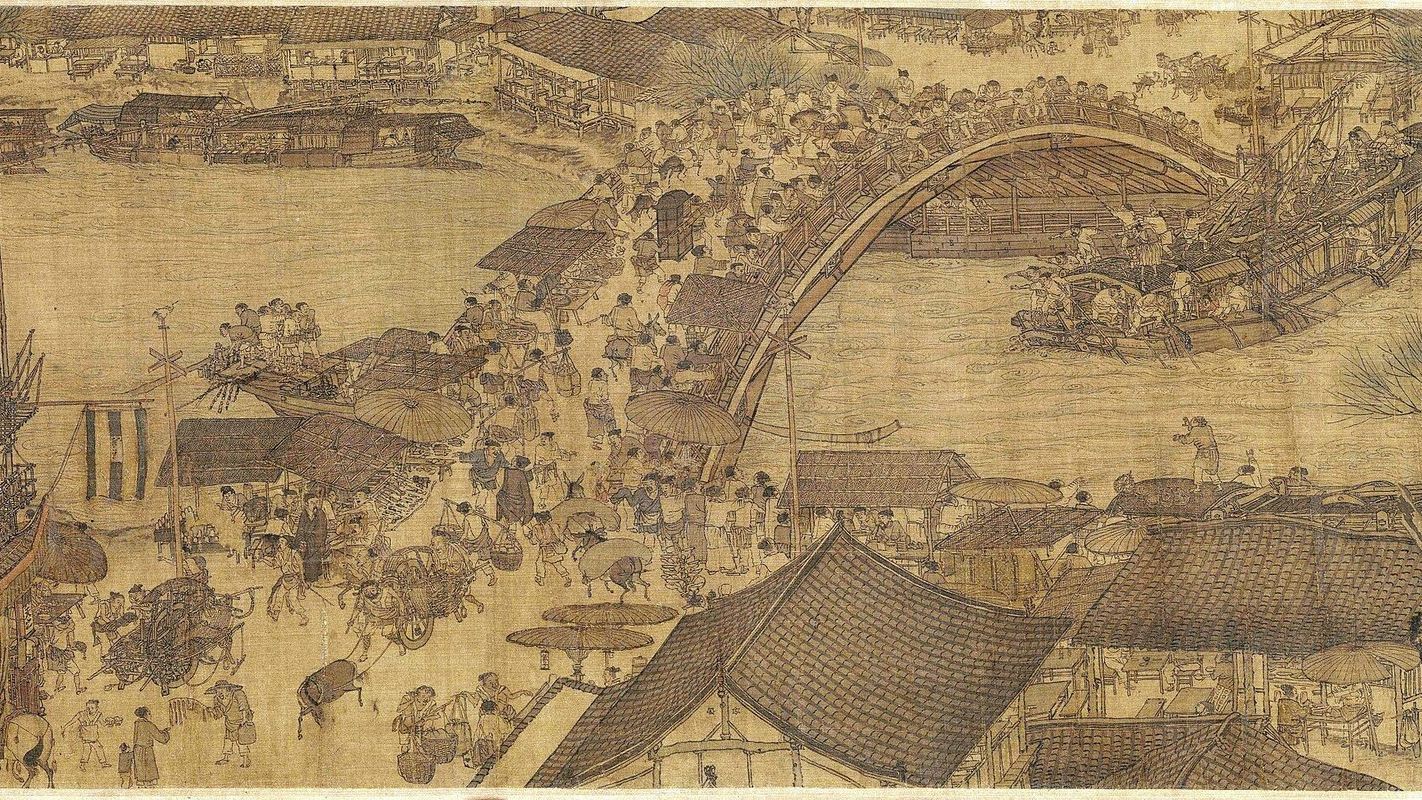
The scroll that every Chinese schoolchild knows is Along the River During the Qingming Festival, painted by Zhang Zeduan in the early twelfth century, at the end of the Northern Song dynasty, in ink and light colour on silk. It is 24.8 cm high and 528 cm long, and it belongs to the Palace Museum in Beijing, which shows it rarely and for short periods. It is as long as a bus and as tall as a sheet of office paper.
Unrolled from the right it begins in the countryside: willows, a donkey train on a path, a farmhouse, the river appearing. The river widens and fills with boats, barges hauled by men on the bank, ferries, a grain boat being unloaded. Then the scroll's famous centre arrives, an arched wooden bridge crowded with people, stalls on its sides, and beneath it a large boat whose crew are struggling to lower the mast in time to pass, while people on the bridge lean over and shout. Beyond the bridge come the city gate, a camel caravan leaving through it, and the streets of the city itself: shops, restaurants with their signboards, a wine house, a fortune teller, scholars, officials, porters, and children, until the scroll ends in a street that continues out of the picture. Counts of the people on it vary, and the figure of 814 is the one usually given; there are also about sixty animals and twenty-odd boats.
Whether it shows the capital, Kaifeng, or an ideal city, and whether it was painted before or after the fall of the Northern Song in 1127, is argued, as is whether the festival of the title is the spring festival of tomb-sweeping or something else. What is not argued is the observation. The rigging of the boats, the joinery of the bridge, and the trades of the shops are drawn by someone who had looked, and historians of Song technology use the scroll as a document.
The copies
A great scroll breeds copies, and the Qingming scroll bred more than any other. The best known is the version painted at the Qing court in 1736 by five painters for the Qianlong emperor, now in the National Palace Museum in Taipei: 35.6 cm high and more than eleven metres long, in bright colour, with the city of a later age and many more people. Copying in China was a form of learning and of homage rather than forgery, and Unit 9 explains why a tradition that valued copying produced both its finest painters and its hardest problems of attribution.
How to look at one in a museum
Museums show handscrolls flat in long cases, fully unrolled, under glass, which is a necessity and a distortion. The way to see one as it was made to be seen is to walk it from right to left at a steady pace, stopping where the painter stops you, and to resist standing back to take in the whole. If the case allows, go back and walk it again faster. A good scroll reads differently at each speed, as a piece of music does.
Most museums with Chinese collections have put their handscrolls online as images that can be scrolled, which restores part of the experience. Unit 9 includes an interactive in which the Qingming scroll is unrolled on screen, section by section, with the bridge arriving when it should.
Unit 9 of the Art History Masterclass, Ink and Brush in China and Japan, draws the four formats to scale, reads the Qingming scroll as a journey, and explains Guo Xi's three distances with a Song landscape. The curriculum describes the unit; a companion article follows a Berlin pigment to the printmakers of Edo.