 Image: User:Patrickringgenberg (CC BY 3.0)
How to draw a ten-point star like a Persian tile maker
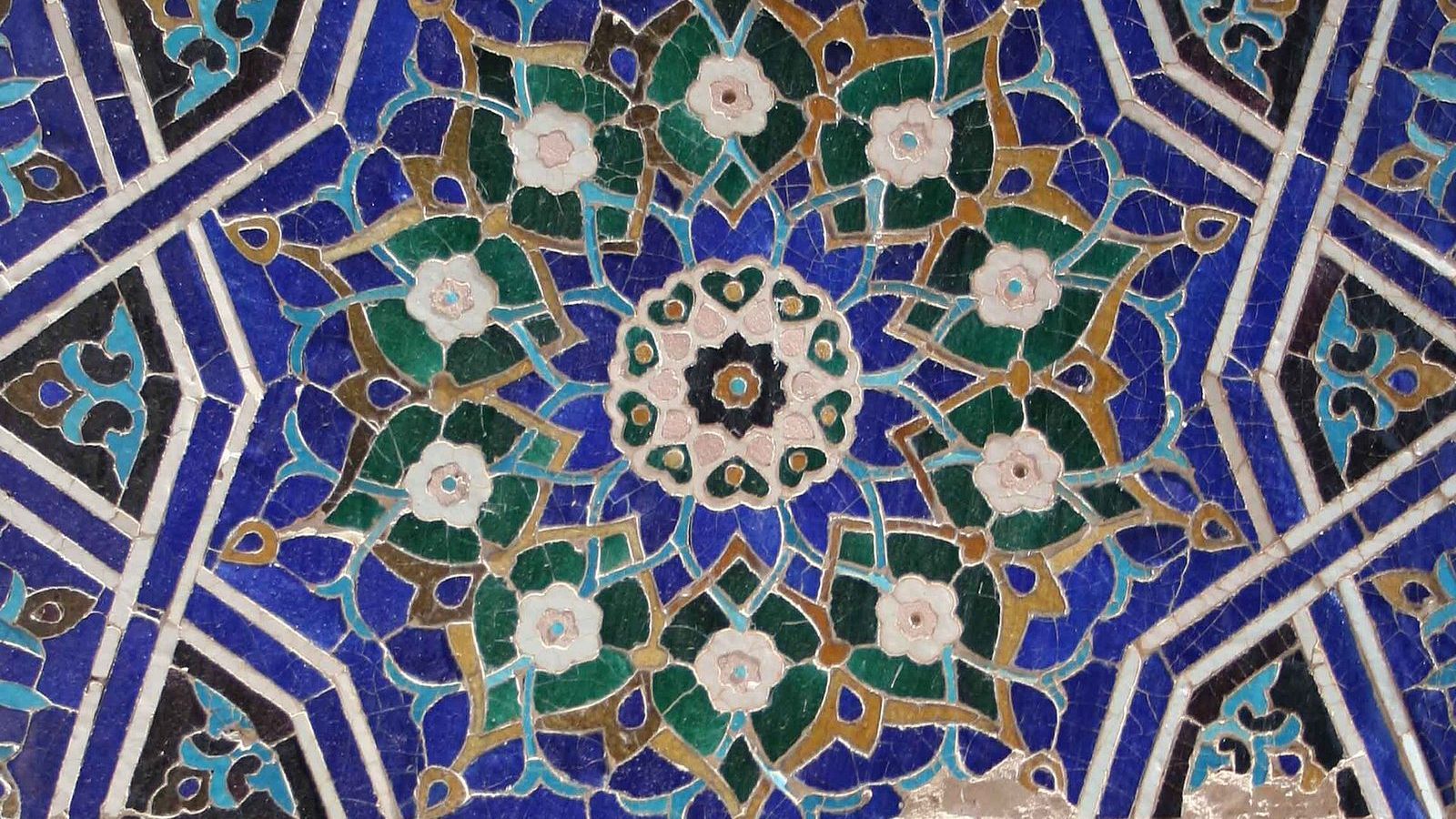
The tiled walls of the Shah-i Zinda in Samarkand, the mosques of Isfahan, and the Alhambra in Granada are covered in stars. They have five, six, eight, ten, or twelve points, they sit in a web of interlacing bands, and the web runs across the wall without a visible seam. The patterns look as if they needed higher mathematics. They needed a compass, a straightedge, and a method, and the method can be learned in an afternoon. The ten-point star is the one that appears most often in Iran and Central Asia, and it is the one to start with.
What you need
A sheet of paper, a pencil, a compass, and a ruler used only as a straightedge, without reading its scale. The tile makers worked the same way, on paper or on a plaster surface, and the drawings they left show construction lines that were never meant to be seen.
The construction
- Draw a circle. Draw a horizontal diameter through its centre and a vertical one at right angles to it, using the compass to find the perpendicular by the usual method of arcs from the two ends.
- Find the midpoint of one horizontal radius by bisecting it. Set the compass on that midpoint, open it to the top of the vertical diameter, and swing an arc down to the horizontal diameter. The distance from the top of the circle to the point where that arc lands is the side of a pentagon inscribed in the circle. Step it round the circle from the top and you have five points.
- Bisect each of the five arcs, or step the compass round again from the halfway mark, and you have ten points equally spaced on the circle. Each is 36 degrees from the next.
- Join every third point with a straight line. Ten lines later you have a ten-pointed star with a smaller ten-sided figure in its middle. Joining every fourth point gives a sharper star; every second gives two overlapping pentagons. Tile makers used all three.
- Now make the lines into bands. Draw a second line parallel to each line of the star, a few millimetres away, so that every line becomes a strap of constant width. At each crossing, let one strap pass over and the other under, alternating as you go round. This is the interlace, and it is what turns a diagram into girih.
- Extend the straps beyond the circle until they meet the straps coming from the next star, and fill the spaces between the stars with the shapes that appear: pentagons, elongated hexagons, bow ties, and rhombi.
The last step is where the system shows itself. A ten-point star cannot tile a plane on its own, because ten-fold symmetry does not repeat on a grid. Designers solved the problem by combining the stars with a small family of other shapes whose angles are all multiples of 36 degrees. Fit them together and the straps run across every joint, so that the eye sees one web and not a set of tiles. In 2007 two physicists, Peter Lu and Paul Steinhardt, pointed out that a set of five such shapes, which they called girih tiles, can produce patterns that never repeat, and that the spandrel of the Darb-i Imam shrine in Isfahan, dated 1453, shows one. Whether the designers knew this in the mathematician's sense is another question. They knew it in the craftsman's sense, which is that the tiles fit.
The Topkapı Scroll
How the designers worked was guesswork until Gülru Necipoğlu, a professor of Islamic art at Harvard University, published a document in 1995. In the library of the Topkapı Palace in Istanbul is a scroll nearly thirty metres long, made in Iran or Central Asia in the late fifteenth or sixteenth century, that contains 114 drawings of geometric patterns and of the plans of muqarnas vaults, the stalactite vaults that hang over the entrances of mosques. The drawings are in black ink with red construction lines, and they show not finished ornament but the working method: the circles, the divisions, the straps, and the repeat unit that a craftsman would scale up to a wall.
Necipoğlu's book, The Topkapı Scroll: Geometry and Ornament in Islamic Architecture, published by the Getty and free to download, argues that the scroll is a pattern book of the kind master builders kept and passed on, and that the geometry in it belonged to a shared culture of mathematics and craft in which the geometer and the tile cutter could read the same drawing. Texts survive of meetings between mathematicians and artisans in Baghdad and elsewhere, in which the mathematicians wrote down constructions for the artisans' use. The scroll is what the artisans' side of that exchange looked like.
Why the method matters
Unit 10 of the masterclass makes two points with the ten-point star. The first is that Islamic geometric ornament is a system rather than a stock of motifs: a few operations with compass and straightedge, repeated and combined, generate an unlimited number of patterns, and the craftsman who knew the operations could design and not only copy. The second is that the ornament is a kind of thinking. The straps that pass over and under one another, the stars that share their points with their neighbours, and the patterns that run off the edge of a panel as if continuing beyond it are statements about order, and in a mosque they are made in the same spirit as the inscriptions that run beside them.
Where to see it
The dome of the Sheikh Lotfollah Mosque in Isfahan, built from 1603 to 1619, is the pattern taken into three dimensions: a lattice of lozenges that shrinks towards the centre, each lozenge filled with tilework, so that the geometry carries the eye upward. The walls of the Shah-i Zinda necropolis in Samarkand show ten-point stars in glazed tile from the fourteenth and fifteenth centuries. The Alhambra's patterns are mostly eight- and twelve-fold. The open archive Archnet has photographs and plans of all three, and the masterclass includes an interactive in which the ten-point star is constructed on screen step by step and then repeated across a wall.
Unit 10 of the Art History Masterclass, Islamic Art and Architecture, constructs the star in a diagram, reads a plate of the Topkapı Scroll as a working document, and presents Gülru Necipoğlu's study as its research spotlight. The curriculum describes it.